Tuesday, August 23, 2011

Sweet Memory Peas

Sharon Wildwind

When I was no older than four my grandmother kept chickens. Her house, like many in the south, was built several feet off the ground. A green, painted, wooden lattice surrounded the crawl space and also provided containment for her half-dozen chickens.

I remembered this yesterday evening because I shelled peas.

One of my uncles occasionally did “favors” for burdened people in the small town. While he didn’t expect payment, they sometimes gave him a loaf of bread, a lawn-mowing, or garden produce, like a mess of peas. He’d haul the slat-sided basket out of his car trunk, set it on the concrete steps by the back porch, and announce, “So-and-so gave me a mess of peas.”

My grandmother would eye the peas and perhaps run her hand through them to see if she was going to keep them. From a distance of half a century I can only guess what criteria she used. Who they came from? The color? The heft of the pods in her hand? How much room she had in her ice box or how much time she had to shell them? Who knows, but if she decided they weren’t keepers, she’d phone what the called “the old folk’s club,” and announce to the secretary. “I got given a basket of peas that I can’t use. Send Joshua around to pick them up and take them any old people who can use them.”

If she decided to keep them, there would be a pea shelling that evening after supper.

Pea shelling happened after supper because that was the only time cool enough to do anything. This was before air-conditioning.

They also happened on the back porch because Lord forbid that neighbors see you shelling peas. I have no clue why this was proscribed, but apparently in our family, food conservation, like the washing of undies, and occasional missing Mass on Sunday to go fishing was no one else's business.

Like crawfish peeling they happened on the screened porch that ran the length of the kitchen. Unlike crawfish peeling, which required layers of newspaper covering the work table, hammers, and pecan picks doubling as crawfish picks, pea shelling required only large brown paper bags with the top folded down to keep them open, a bushel basket of peas, and several bowls. Pea shelling also required copious amounts of sweet tea, but since this was the south in summer, all back porch activities required copious amounts of sweet tea. I suspect in some places, they still do.

Peas with any sign of mildew or worm damage were discarded, unshelled, into one of the brown paper bags.

The older son — my uncle who’d brought the peas home — was pea snipper. He used a toenail clipper, thankfully kept only for shelling peas, to snip a cut two-thirds of the way through pod at the attachment end. He’d pass the clipped pea pod to his younger brother — my other uncle — who was pea stringer.

He grasped the cut end of the pod and pull the string off, just like he was opening a zipper. The discarded string went into the paper bag with the rejected pods. The clipped and stringed pod was tossed into a large bowl from which the shellers drew their lap stock. Since the two men working in tandem could snip-and-string the entire bushel before the shellers were anywhere close to finishing, they were took their ease while the rest of us worked.

My grandmother, mother, aunt, cousin, and myself were the shellers. Strong well-formed thumbnails were an advantage because they could pop shells open. Since I had nails with neither good configuration or strength, I was given a butter knife to be inserted into the open end of the shell and twisted to pop the pod open. My ragged, bitten fingernail status was no barrier to running my finger down the pod to send peas cascading into a Pyrex bowl on my lap. I always asked for, and got, the blue one.

Most peas were shelled as background to gossip, often carried on in French because children were present. Occasionally a pod would be held out for silent assessment by the pea team.

The tisk-tisk pods came in two varieties: the under-achievers either held no peas or miniscule, premature green dots; these were tossed into the pea shell bag. The over-achievers were crammed to bursting, sometimes literally, with peas grown so big that they pushed up against one-another, turning round peas into flattened spheres. Both were accompanied by a guttural clacking in the back of the throat that said, “Clearly not up to standard.”

Rarely a pod would be held up for mutual admiration. Perfect color, perfect number of peas in the pod, well spaced, perfectly rounded peas. A 9.92 score in the pea Olympics. The fortunate sheller who found one was allowed to eat it. The theory being, I suppose, that such perfection shouldn’t be lost by dumping it in a bowl with lesser competitors. And we were each allowed to eat the last pod that we shelled, so we always set aside the biggest, fattest pod for that final treat.

What does all this have to do with chickens? When I sat shelling peas yesterday evening, I suddenly remembered my grandmother scattering the contents of the pea pod bag on the ground, and chickens running out from under the house to feast. I hadn't thought about, even remembered, my grandmother's chickens in decades.

What does it have to do with writing? I’ll let this week’s quote answer that.

Memories are hunting horns whose sound dies on the wind.
~Guillaume Apollinaire, (1880 – 1918), French poet, playwright, short story writer, novelist, and art critic

The Pea Pod Fairy says when a good memory comes along, grab it quick and write it down before it dies on the wind.

Monday, August 22, 2011

Taking Mothering Too Far?

by Julia Buckley
My friend Lydia (the same one with the birthday clusters theory), once told me, during a philosophical discussion about death, that she would, if given the choice, "haunt a few people." She said this not with any vengefulness, but with more of a cheerful tone. If haunting is a possibility, she's going to go for it. :)

I explored this idea further in a story called "Motherly Intuition," which appears in Anne Frasier's just-released Halloween Anthology, Deadly Treats. In the story, a young woman named Daphne, still grieving the recent loss of her mother, is annoyed to find a voice in her head that is not her own. She consults a psychiatrist, who fears schizophrenia, but Daphne comes to realize that she is somehow talking with her mother, and although she is thrilled about this new avenue of communication, she also realizes that--even as a disembodied thought--her mother has retained the power to annoy her.

Still, Daphne is glad that her mother is watching over her when danger comes calling on Halloween night . . . .

Anne Frasier has put together a fun group of tales, a delicious variety of mystery, suspense and horror, many of them darkly funny. Anne herself claims Halloween as her favorite holiday, and she wanted to make this book for people who love All Hallows Eve and its traditions as much as she does.

So here I offer you the first taste of fall (unless your stores are already putting Halloween stuff on the shelves) in the form of some fun holiday reading.

Bill Cameron, who has been interviewed on this blog, contributed a terrific short story about his retired Portland detective Skin Kadish. Other contributors include Crimespace creator Daniel Hatadi, Editor Anne Frasier, Theresa Weir, Heather Dearly, Patricia Abbott, Pat Dennis, David Housewright, Stephen Blackmoore, Mark Hull, Leandra Logan, Marilyn Victor, Lance Zarimba, L.K.Rigel, Jason Evans, Paula L. Fleming, Shirley Damsgaard, Paul D. Brazill, and Michael Allan Mallory.

As they say in the ad world, Get your copy today!!


Saturday, August 20, 2011

Canada Calling: Canadian Publishers

Ever considered publishing in Canada? Given below is a list of the major mystery publishers in Canada and their current status about if they are accepting submissions.

Most of the publishers listed below have on-line submission guidelines. Most also DO NOT accept e-mail queries or submissions. This means you must send your query by snail mail, and include a self-addressed, stamped envelope (SASE) which brings up those pesky International Reply Coupons.

Unless you live in one of the 10 Canadian provinces or 3 Territories, Canada is another country. A Canadian publisher can not mail an SASE back to you using the stamps of any other country, so they require that International Reply Coupons be included in any query.

If you’ve ever tried to buy International Reply Coupons (IRCs) you will know that they are expensive and hard to find. If getting IRCs is a problem, contact the publisher personally to see if they would accept you sending them Canadian stamps, which can be purchased over the Internet at face value, or if you live near the Canadian border, you can pop across the border and buy them in person.

There are three kinds of Canadian postage. One is intended for use only inside of Canada and will not work to go to another country. You can tell these stamps because they have the letter “C” on them instead of a dollar amount.

The second kind is for letters mailed inside of Canada to go to the U. S. Buy stamps to use on letters going from Canada to the U.S.

The third kind is for letters mailed inside of Canada to go to any other country expect the U.S. Buy stamps to use on letters going from Canada to any country except the U.S.

Keep in mind that Canadian postal rates will increase on 2012 January 1. Current rate calculator for mailing a letter/package inside Canada to other countries. 2012 January 1 increases for mailing a letter/package inside Canada to other countries.

Now that we have those pesky details out of the way, here is a list of publishers. Some are not currently accepting submissions, but their web sites say check back from time to time, as this may change. Publishers have been arranged alphabetically.

ChiZine Publications
Location: Toronto, Ontario

Seeking 60K-100K manuscripts. See on-line submission guidelines. They are a dark fiction genre publisher. This includes science fiction, fantasy, horror, magic realism, industrial thrillers, etc. Interested in pushing the boundaries with the unusual, the outré, and the transgressive.

Dundurn
Location: Toronto, Ontario

Publishes both adult and young adult mysteries. See on-line submission requirements.

ECW Press
Location, Toronto, Ontario

Publishes only Canadian authors. See on-line submission guidelines. Send query and sample by snail mail.

EDGE Publishing and Tesseract Books
Location: Calgary, Alberta

Seeking novel-length science fiction and fantasy submissions of all types. See on-line submission guidelines. Send query letter and synopsis by snail mail.

Insomniac Press
Location: Toronto, Ontario

Special interests: gay and lesbian books, noir mysteries. See on-line submission requirements. Send snail mail or e-mail query first.

McArthur & Company Publishing Ltd.
Location: Toronto, Ontario

Currently not accepting unsolicited mystery manuscripts. If you have an agent, go through him/her.

OnSpec Magazine
Location: Edmonton, Alberta

See on-line submission guides. Seeking original, unpublished speculative fiction (SF) and poetry -- fantasy, horror, ghost stories, fairy stories, magic realism, etc. Send your short stories (max. 6000 words), short short stories (under 1000 words) or poetry (max. 100 lines) by snail mail.

RendezVous Crime
Location: Toronto, Ontario

Unfortunately, they are not accepting submissions at this time, but keep an eye on this site. Lots of Canadian mystery writers publish here.

Ravenstone Books
Location: Winnipeg, Manitoba

Publishes only Canadian citizens or landed immigrants, but will accept submissions from Canadians living outside of Canada. See on-line submission guidelines. Wants query first by snail mail. Interested in hard-boiled, police procedural, private eye, suspense, and thriller. At this time not considering cozies or "special knowledge" manuscripts.

NeWest Publishing
Location: Edmonton, Alberta

Not accepting mystery submissions at this time, but writers are encouraged to check back for updates.

Friday, August 19, 2011

They Just Keep Going

by Sheila Connolly

I own six vacuum cleaners.

This is not because I'm a neat freak (I'm not), or because I live with three cats who shed a lot.  It's because the blasted things will not die (hmm, zombie vacuum cleaners?).

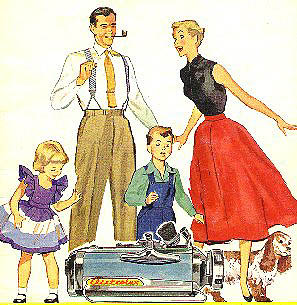
It all began innocently enough.  When my husband and I were married (35 years ago this month!), we were broke, so we bought a reconditioned Electrolux cannister model, because that's what my family always used.  Guess what:  it's still going.

When my grandmother died, somehow I inherited her vacuum.  Now, she was a neat freak, but she lived in a studio apartment in New York, so it didn't see a lot of hard wear.  Guess what:  it's still going.

Yes, that's the one
My mother, based on her mother's example, also had an Electrolux.  I remember when she proudly upgraded, ca. 1962, to a fancier model--with what she called a Rug Beater attachment.  I remember when she proudly upgraded, ca. 1962, to a fancier model--with what she called a Rug Beater attachment (she demoted her earlier one to the basement). Forty years later, the belt broke. I went straight to the Internet and found a replacement part in minutes. What was interesting was that when I disassembled the head, the brush roller was wooden. Fancy that!


When my mother passed on, I inherited both of her vacuum cleaners. Now I was up to four, all in working order. I nearly celebrated when a cord crumbled (from age, of course) on one model, and I could officially retire its predecessor to cannibalize the cord from that. The replacement was easy, and the decorded one is still around, having given its all to provide spare parts.


The other two are shop vacs. When we moved into our home in Pennsylvania, we knew that it would required a lot of renovation, and we needed something heavy duty, so we bought a hulking big model--a sixteen gallon wet-dry vac (Sears, but only because I don't think Electrolux makes one). Guess what: it's still working (although it makes a shriek like a dying dinosaur when you turn it on, and it lost a roller foot years ago so you have to drag it around). We ended up with a second one when my stepfather passed away a decade ago. It's still going too (also minus a roller--in sympathy?).


Six vacuums, and I can't seem to get rid of any of them. I'm haunted by undead vacuums. But there's something endearing about an appliance that is so well made that it simply will not stop working. Obviously the marketplace recognizes this, because vendors are happy to supply all and any parts. But even that must be a slow business, because apart from bags, I've bought a grand total of two replacement parts in forty years. Those things are indestructible, and I respect that.


But technology has changed, and I'll admit to coveting a Dyson with that cool and colorful ball and its own little tornado. The problem is, I don't need it. I'm stuck back in the technology that was born in the 19th century, because it still works. And in this era of throwaway appliances, that's something of a miracle.


What's your oldest working appliance?


Thursday, August 18, 2011

The Current Crop of Clichés

Elizabeth Zelvin

I wish I could say that every writer knows how important it is to keep his or her language fresh. In theory, none of them would deny it. Yet all too often, I find myself reading the same tired old phrases and misapplied words. Leafing through a recent read, I found “a knee-jerk reaction,” “a vibrant industry,” “the spitting image,” “short and sweet,” “like he’d seen a ghost.” It’s one thing to use such expressions in dialogue, another in narrative. But that is not actually my beef today. I would like to complain about the fact that in addition to the old clichĂ©s, we now have an abundance of new clichĂ©s to guard against. Where did they come from? How did they spread so fast? And why, oh why do so many writers insist on using them?

When, for example, did “night and day” (or “day and night”) become “24/7”? When did “back in the old days” or “way back when” become “back in the day”? How did a simple “never” turn into a facetious “not anytime soon”? Actually, that one charmed me the first time I saw it, in Rosemary Harris’s first mystery. When her wisecracking suburban protagonist meets a hostile and suspicious female police detective, she says, “We were not going shopping together anytime soon.” But all too soon, I saw the same expression everywhere. Note to self: if “anytime soon” (or “back in the day” or “24/7”) should inadvertently trickle from your fingertips, delete asap!

I know where “thirtysomething” (and its derivatives, “twentysomething” and “fortysomething,” if not “fiftysomething”) came from: it was the title of a TV series that debuted in 1987. The term entered the Oxford English Dictionary in 1993, where it was qualified as “specifically applied to members of the ‘baby boom’ generation entering their thirties in the mid-1980s; also attributed as an adjective phrase (hence, characteristic of the tastes and lifestyle of this group).” But the baby boomers are now “the new thirty,” ie in their sixties, and I’ve seen manuscript after manuscript in which “thirtysomething” appears simply to denote a character in his or her thirties. Published books, “not so much”—another overused phrase that has emerged in the last couple of years.

Have you read advertising copy for clothing lately? When did “pants” or “pair of pants” become “pant”? Men can buy “The North Face Men’s Outbound Pant” at Zappo’s—for one-legged mountain climbers, no doubt. “The Polo Ralph Lauren Hudson “Preston” Pant” at Bloomingdale’s—for one-legged polo players, maybe? On the other hand, at Eastern Mountain Sports, some of whose customers really are going climbing, they can still find “North Face Men’s Outbound Pants.” My one consolation with this one is that, as far as I know, nobody but advertisers and maybe retailers is using “pant” as a noun.

The most recent shift in usage that I’ve noticed, this one more in the spoken than the written word, is “iconic” for a variety of perfectly good adjectives with a number of different meanings: “classic,” “typical,” “best known,” “original,” and “household word.” Where did that one come from? You will probably be able to visualize the item I have in mind, whether I say “an iconic Coke bottle” or “a wasp-waisted Coke bottle”—but one is neo-clichĂ©, while the other, I hope, is prose.

Wednesday, August 17, 2011

The Bears

by Kathleen George
Author of Hideout


I was on a mini book tour—Cape May, Brooklyn, Provincetown—and when I hit Provincetown I walked around for a few days puzzled at signs that said things like “Bears Welcome Here.” 

One night it poured. Through our window my husband and I could see a party next door, men shoulder to shoulder under, oh, fifty umbrellas in the torrential rain. We hopped over puddles and two buildings away to a restaurant (Pepe’s) for dinner. From our table we had an even better view of the partying men and what appeared to be a large martini bar. It was still pouring. I asked our waiter, “Is that another restaurant next door or a house?”

“A house,” he said. “Those are bears.”

“Does that mean large men?” I asked, for there were certainly a good number of large, very large, men about.

He said, “Large and hairy. Supposed to be hairy.”

That’s when I realized that the two men who rented the place above us were bears. We heard them crashing around and lumbering down the steps. Oh, and the two guys looking for the JP in order to get married on our deck, they were large, too. And going up and down Commercial Street I could see many bears. Every once in a while a medium-sized man edged in on the group and I thought I could sense his wanting to be bigger.


I learned more as the week progressed. My friend Betty explained that it was Bear Week in Provincetown. There were other designated weeks. Family week, etc. I learned that bears are amazing. They’ve formed an organization and they keep up a clear set of postings and they sponsor events in Provincetown and other places.

“Provincetown loves the bears,” Betty told me. “The store owners and the gallery owners are always happy to see Bear Week. For one thing they are the nicest and happiest people you will ever see.” This seemed true on simple observation. I’d seen a lot of happy large men walking down the street holding hands. Often they were muscular but also often they were overweight. I was reminded that dieting sucks. “They’re cheerful, they tip well, and they like to hold hands.”

So the town was filled with good spirits and good will. “Why are they so especially happy?” I asked my husband. “Do you think it’s that they eat whatever they want?” Me, always back to food.

My husband answered me after a thoughtful pause. “They’ve done what all people need to do. They’ve organized. They’ve identified themselves and made a community that makes them feel good, that gives them support and makes them belong.”

Of course. I gravitate to writers. I even married one. That’s the club I most want to belong to. I am never so happy as when I am with a group of writers. Art colonies are great for this reason—that immediate understanding of each other. I also love my lunches with writer friends who happen to be writing crime fiction. We are always eager to see each other and everybody has a lot to say. One of our number burst into a restaurant one day and announced happily, “I had a great morning. I just killed someone with a rake.” The other people in the restaurant looked up, alarmed. But we ignored them and burbled along, feeling happy for our friend who’d had such a good morning.

What is your other “family?” What is your “Okay to be big, hairy, and gay?”

To learn more about Bear Week, go to: http://www.ptownbears.org/faq/faq.asp

 
Kathleen George is the editor of Pittsburgh Noir and the author of Taken, Fallen, Afterimage, The Odds (Edgar finalist, best novel), and Hideout, just released. For more information about Kathleen and her work, visit her website at http://www.kathleengeorge.com.

Tuesday, August 16, 2011

Difficult Scenes

Sharon Wildwind

I had a great time this past weekend. A group of talented people, some of whom I’ve known for a quarter of a century, organized a cross-genre convention called When Words Collide. The convention brought together romance, science fiction, fantasy, horror, and mystery writers so that we could share what was alike and different about our different geners.

These are the notes from the panel I went to about writing difficult scenes. Usually I like to credit who said what, but the room was packed. I sat on the floor, in the back of the room, where I heard the speakers, but couldn’t see who spoke when. So I’ll give everybody credit for everything.

The panelists were Susan McGregor (editor, speculative writer, and writing teacher); Jennifer Kennedy (science fiction and fantasy writer, and storyteller); Barb Galler-Smith (historical fantasy writer and editor); Lynda Williams (fantasy writer and editor); and Lauren Hawkeye (writer and theater enthusiast).

What makes a scene difficult for a writer is any emotionally-charged material. Sometimes the material is related to an emotional loss the writer has previously experienced, or a story that scares a writer so much she may become physically sick.

Very often a writer worries about how someone she loves, especially a parent or other family member, will react to reading the scene. The counter point is that writing difficult scenes are times when the writer grows both personally, and in her craft.

Common uncomfortable scenes include
~Sexual material, erotica, sexual politics, rape, alternative sexual lifestyles, or soft porn
~Loss of a character’s innocence: some writers have a hard time emotionally damaging characters they love.
~Violence particularly towards women and children. One of the hardest things a writer can try to accomplish is to make historical violence both accurate and tolerable to a modern reader.
~Moral dilemmas, especially those where heroic characters show their dark sides, and make choices that are unfair, immoral, or unjust.
~The death of a character.

The writer needs to know what frightens her and why she’s frightened. There is a huge difference between writing as therapy and writing a work to sell. A writer can’t force her way through the first by concentrating on the second. If a writer has had a horrific experience, she must take whatever time and help she needs to heal before she tries to give voice to that experience in a commercial manuscript.

Be honest about the scene being gratuitous. If it does not advance the plot or change the character in a major way, why include it? These are not the kind of scenes to use as fillers.

Know your characters; know that this scene must happen; know that there is no stopping the scene; and know that this is a scene where you can’t pull any punches. Writing around a scene, and thinking you will come back and “fill it in” later is a bad idea. Delaying a difficult scene makes it harder to come back later to write it, and harder to go on with the rest of the story. There have been situations where a writer gave up on a story rather than face a difficult scene.

Write something to fill the scene, even if it is an outline or a draft. Some writers use stereotypes to get themselves through the first draft. Good writers go back later and write beyond the stereotypes to full, rounded characters.

Other writers start by technically setting up the scene: the lighting, time of day, which character stands where, etc. Once the characters are in place, the author gets out of the way and lets the characters have their way. She writes one word at a time.

If you’re having trouble understanding what the character feels, start with a small event in your life. Think about the time you thought your credit card had been stolen. What emotions did you have? Extrapolate those emotions to a larger scale. Instead of a credit card, how would you feel if you thought your child had been stolen?

Pick other people’s brains, either in person, or by reading what people who have been through the same difficult situation have written. You have to write from your head, heart, instinct, and baser passions, like lust. Readers and writers share all of these parts, so you have to include all of the parts in your writing.

Forget thinking, “Is it all right if I write a scene like this?” or “What will so-and-so think when he reads this scene?” Just do it. Get it out on paper. Readers are whole people with complex motivations and reactions. As writers, we don’t know what will be motivating them when they read this scene. They might be at a place where they need to express anger and your scene may help them do that. They may also be at a place where they need to close the book and go away for a while. Don’t try to second-guess a reader.

Know your audience. Intentionally mismatching material and projected audiences is a power trip. You want to engage your audience where they are, and then take them one step further. For example, if your readers are likely to be uncomfortable with a homosexual relationship, just a mention of the relationship may be all they can tolerate. You can not force them to go two, five, or ten steps further than where they are today by being graphic and upping their discomfort.

If readers lose hope, writers lose readers. No matter how bad a situation gets, there must always be a glimmer of hope that the character will survive, or if the character is to die, a glimmer that the people around them will grieve and survive.

Allow difficult scenes to end a chapter. Do not attempt to bring the reader in for a gentle landing. Give the reader the luxury of closing the book at this point, so that they can go away for a while to think, cry, throw the book across the room, or decompress.

When they do come back, humor, lightness, or comfort may be needed for a few pages. Shakespeare frequently used people like gravediggers or doormen as relief characters. Aim for a balance that gives the reader a chance to pause and grab his breath. Your goal should be to make the reader want to come back to the story after a break.

Monday, August 15, 2011

Farewell, Summer Reading . . .

by Julia Buckley

I start work again this week, which is probably a good thing--in my summer laziness I've stopped accomplishing as much as I should and I've actually gained weight--but one thing I'll miss is the chance to read more books.

This summer I've read some terrific titles and become absorbed in wonderfully labrynthine plots. Here were some of the highlights:

Cradle in the Grave: This was my first exposure to Britain's Sophie Hannah, whose book has been released in America and which is a fascinating mystery surrounding the stories of three different women who have been accused of killing babies--in two cases their own children, and in one case a child of a friend.

Hannah's writing is intelligent, gripping, and ultimately impossible to put down.

The Janus Stone: This is the second in Elly Griffith's series, and it was just as compelling and well-written as the first, THE CROSSING PLACES. I'm a Griffiths fan!

Bossy Pants. Tina Fey's biography is far from a mystery, but it made me laugh out loud on several occasions and ended up being a reading highlight of my summer.

I Think I Love You: This second novel by Allison Pearson, the author of the bestselling I Don't Know How She Does It, was a nostalgic look back at the 70s and the pop reign of David Cassidy. But it's also about girlhood, friendship, families, and growing up. I loved it.

The Redbreast. This was my first taste of Norwegian Jo Nesbo's writing--an article in TIME likened him to Stieg Larrson, so I thought he was worth a read. It took me a while to get into this story, but once I did I was hooked--although it has many disturbing parallels to the actual brutality that just occurred in Norway. (Nesbo wrote a moving article about the unprecedented violence in his country after the terrorist attack).

Hell is Empty. As I mentioned before on this blog, there is no one in the mystery world right now who is quite as stylish and elegant as Craig Johnson, and this book, with its layers of literary allusion and Native American legend, was both spiritual and suspenseful. You can read my essay comparing Johnson to Ross MacDonald on this blog, here or read one of my interviews with Johnson here.

The Man in the Rockefeller Suit. Mark Seal's non-fiction look at a real-life con man was fascinating and sometimes unbelievable. It seems destined to be made into a movie in the style of Spielberg's Catch Me If You Can. (I interviewed Seal about the book here).

I read quite a few more great books this summer, even though I was lazier than usual and wasted far too much time playing Lexulous on Facebook. But these were the first that sprang to mind as good reading recommendations.

What great books did you read this summer?


Saturday, August 13, 2011

Dark Heroes and the Moral Code

by guest Misa Ramirez/Melissa Bourbon


I’m a mystery writer.  My Lola Cruz Mysteries with St. Martin’s Minotaur are soft-boiled.  My new Magical Dressmaking Mysteries with NAL (Pleating for Mercy was just released on August 2nd) are cozies. 


I also have an upcoming romantic suspense based on the haunting Mexican legend of la Llorona.  It's much darker than my other books. 


Shifting from writing smart, sexy, sassy mysteries to small town cozies to darker romantic suspenses sometimes makes me feel as though I have multiple personality disorder!  There's never a dull writing day, that's for sure. 


When I began to think about a darker story, I automatically focused on the dark hero.  The damaged heroine.  And I got into Dexter. 


I should note here that I'm a teacher, as well (Southern Methodist University with the creative writing CAPE program and Savvy Authors).  One thing I love about teaching is that it forces me to continue my own learning in new and unexpected ways.  Discovering a new (to me) television show and realizing it can teach me something about characterization, is thrilling.  I went through this with Supernatural (love love love those Winchester boys).  I went through it with Lost (rife with conflict, those plane crash victims were).  I’m going through it with Breaking Bad (Walter White is one heck of a conflicted cancer victim).  And I’m going through it with Dexter.


If you haven’t seen Dexter, here’s the lowdown:


Dexter Morgan is a forensic scientist. He studies blood spatter. This television series is based on a series of novels by Jeff Lindsay, although, in the vein (no pun intended!) of True Blood, the series has taken on a life of its own.   My observations are based on the TV series, not the books.


The further into the shows I watched, the more I wondered: Is Dexter a Villain or a Dark Hero?


My take on Dexter is that he walks a thin line between being a dark hero and a villain.  This line is blurry and complicated; he is fascinating, which makes him an excellent case study.   One could probably write a dissertation on the subject, in fact.  The bottom line?  He's a layered character who does horrible things for all the right reasons.


The show has been great food for thought when it comes to crafting my own characters (for any of my different series), developing their layers and depths and figuring out how to build conflict into my stories (particularly in the romantic suspenses like A Deadly Curse which are, by nature, dark).


When I develop a character, good or bad, I craft his/her moral code.  Even the darkest hero and the villain have a moral code.  It may be twisted or skewed, but it exists and in his/her mind and actions are justified because of the code.  I’ve always written this way, but the point was driven home as I watched the end of season one in Dexter.  We began to see flashbacks to Dexter’s adoptive father and the code he helped Dexter establish.  Harry’s Code.  It’s the guiding force in Dexter’s life, informing all of his decisions.  It’s his moral compass. 


Dexter is an anomaly within humanity in that he doesn’t feel anything. He says he has a hole inside him where those feeling should go. If he could feel something, he’d care about his sister, also a cop.


Harry, Dexter’s father, steps in to help Dexter adapt to the world he lives in. He teaches him how to survive, kill effectively and efficiently, how to never get caught, and, on an emotional level, how to interact with the people around him so that he can fit in.


We all have our own moral code, we just don’t recognize it or live by it as intentionally as Dexter.  But when crafting a character, knowing his/her code can help you stay authentic to him/her.  As I am writing the third book in the Lola Cruz Mystery series, Bare Naked Lola, the mystery takes Lola to a nudist resort.  The big question (one I haven’t answered yet) is, “Will she or won’t she?”  Go naked, I mean.  See, Lola lives by a code of striving for gender equality, seeking justice, being true to her sexy, sassy, smart, kick-ass self, preserving her family’s culture within her life, and respecting herself and her family.  She’s also a good Catholic girl.  A few of these elements conflict when I try to answer the question of whether or not Lola’ll take it all off in order to solve a case. (You’ll have to stay tuned to find out the answer!)


Harlow Cassidy, the sleuth in Pleating for Mercy, has her own moral code, as well.  It revolves around the idea of justice, preserving the safe, small town Texas town she grew up in, and keeping family close and safe.  She's not an ends justifies the means kind of woman, but she is a go-getter, willing to put herself on the line if it's the right thing to do.


Just like in Dexter, people can make a choice to go against their code.  There are consequences to those decisions, and in a book, that’s exactly what you want.  If Lola doesn’t go nude, she upholds parts of her code, but sacrifices other elements.  If she does, she may solve the mystery, but will she respect the decision knowing what she did and how she compromised?  Does the end justify the means? 


In A Deadly Curse, someone is killing women and making it look like the drownings of la Llorona, a 500 year old mythic woman (think Madea).   The killer lives by his own code and sees what he does as justified.  Skewed, yes, but authentic.


Now, Dexter’s backstory is important in framing who he is (as is the case for any dark hero...or any hero, for that matter). Dexter witnessed his mother being killed, which is the catalyst for his emotional emptiness. This also drives his bloodlust and desire to hurt those who are hurting others (as he does with a dog who constantly yaps and irritates his adoptive mother to the point that she can't sleep), thereby achieving a warped sense of justice. With Harry’s guidance, he develops the “Code”--to only kill those who “deserve” it (those who are killers themselves). The God Complex here is obviously huge, and the whole premise is layered with moral dilemmas.


Things get more complicated for Dexter as he continues to ‘role play’ his emotional attachment to the few people he pretends to care about (his sister, a girlfriend, and her / his children). The other fundamental conflict, or course, is that he works in law enforcement, yet he breaks the law--in a big way--every time he kills.  His secrets are close to being discovered more than once.


But from the beginning, we witness a process of humanization in Dexter because we understand why he is bereft of emotions, where that hole in him stems from, and when he begins to question his own code, we see his deeper moral dilemma. This character truly straddles the line between villain (because how do we ever condone a killer and this God complex?) and dark hero (because we see the good in his intentions). When he begins to recognize ‘real’ feelings within himself, the ambiguity of his ‘hero’ status deepens right along with his moral conflicts.


This is a fascinating, albeit violent and graphic, show (I cover my eyes... A LOT!). Despite the gruesomeness and violence, I love it, as I also love Breaking Bad, because this character is so fundamentally conflicted. The conflicts manifest in very unexpected ways. Watching both of these shows makes me really question and think about moral coded and values, applying what I know to my own characters and their development. 


A great character, dark or not, will force us to look more closely at ourselves, to examine what we think and feel, and any character who can make us do that is well worth watching or reading about, and will, ultimately, help us as we build our own conflicted, real characters--no matter how light or dark the book.

 
What do you think of Dexter (if you’ve seen the show and know the character)? Do you think he’s a villain or a dark hero?


Melissa Bourbon, who sometimes answers to her Latina-by-marriage name Misa Ramirez, gave up teaching middle and high school kids in Northern California to write full-time amidst horses and Longhorns in North Texas. She fantasizes about spending summers writing in quaint, cozy locales, has a love/hate relationship with yoga and chocolate, is devoted to her family, and can’t believe she’s lucky enough to be living the life of her dreams.

Visit Melissa at her website http://melissabourbon.com
Melissa on Twitter http://twitter.com/MelissaBourbon
Melissa on Facebook  http://www.facebook.com/AuthorMelissaBourbon.MisaRamirez


And at Books on the House, a website bringing books and readers together!
http://booksonthehouse.com


Friday, August 12, 2011

Taking the Long View


By Sheila Connolly

Conventional wisdom in the writing business is that it takes five years to land a contract, and I hit that mark--barely. Now I realize it's been almost exactly five years since I received "The Call." Things move slowly in the print universe, although obviously ebooks are changing the playing field, and both sellers and buyers can achieve instant gratification.

But I guess that makes me the last of the old pre-Internet generation, when things moved at a leisurely pace. I can live with that. But what I wanted to write about was my orchard.

Okay, six trees does not an orchard make. But when I started the Orchard Mystery series, I thought I should get up close and personal with the real thing. Much as I love driving around New England visiting orchards, both old and new, I always seem to miss that magic moment when they start blooming, or arrive a week after they've picked the heirloom varieties. The only way I could really follow the seasons in an orchard would be to plant my own.

Small problem: our property is a quarter-acre, and much of that is taken up with a house and a former barn and a driveway. Half of what's left is heavily shaded, and apple trees like sunlight. That left me with a narrow strip smack in front of the house. Okay, the neighbors were going to think I was a little weird, but I started planting apple trees.

It's not as silly as it sounds: most apple trees these days are grafted onto dwarf stock, so it's not like there will be a forty-foot tree in the front yard any time soon. But I also wanted to add to the challenge. I didn't want to plant the easy stuff like Macintosh; I wanted to plant heirloom varieties, trees either native to New England or with historical value. Those you have to hunt for.

My orchard
My first tree was a Northern Spy. I shouldn't have started with that, because they're notoriously slow to produce fruit. Was I prepared to wait five years or more to see an apple? But I'm stubborn, and that was what I wanted, because they're good all-around apples, useful for both eating and cooking. I even found a nice eight-foot tree--near where my daughter was in college (which happens to be near where I set my series). That presented a problem: how to haul it across the state? In the end my daughter did manage to cram it into one of our older cars and carried it home, and I planted it.

Hudson's--yes, they're golden
The second tree was a Cortland that I did find at a local nursery. Cortlands are nice dependable producers, and I wanted something that I was pretty sure would actually yield apples. That went in next to the Northern Spy. After that I started getting a little crazy: an Esopus Spitzenberg, because it was Thomas Jefferson's favorite apple; a Hudson's Golden Gem, because my daughter liked the catalog description; and this year I added a Newtown Pippin and a Roxbury Russet, both old and well-established varieties (I've read that the Roxbury Russet was the first apple produced in this country, and Roxbury is not far from where I live).

Along the way I learned that apples produce only on second-year growth, so I couldn't expect much from my new plantings (which arrive looking like three-foot sticks with some roots attached--not convincing). Last year the Northern Spy and the Cortland produced blooms (you have to have two trees to cross-fertilize), but there was a March freeze, and...no apples, not a one.

Let me add that the Orchard series is set in a real place built by an ancestor of mine, and like all old New England homes, it once had an orchard--of which all of two trees remained. One of those succumbed to a winter storm a couple of years ago, and I cut a lot of grafts from it and brought them home--and read about how to graft, because I had never done it. I diligently followed instructions, and grafted a dozen or so bits of the old family tree (a joke there) to my established trees, and crossed my fingers. One and only one took, but that was better than nothing.

My grafted branch!
This year the spring went well, with plenty of blossoms. And then I started inspecting the trees daily (like every time I walked by) and saying encouraging things to them (yes, out loud). And...the four elder trees have apples this year. Yes, even the reluctant Northern Spy and the grafted branch. All right, maybe it's only a couple of apples each (save for the Cortland, which is going gangbusters), but it worked!

Cortland
Maybe it seems silly to get so excited about a natural process that's been going on for millennia, but they're my first apples, and I feel like a proud mother. I still go out and talk to them. It's going to be a challenge to wait until they're truly ripe (and that Northern Spy is one of the late ones).

If there's a message for writers buried in here somewhere, it's that things don't happen fast, and that's the way it is. But with patience and perseverance and luck, you'll get a harvest eventually.  In my case, I've got both books and apples!