Saturday, May 12, 2012
A Spark to Ignite Ideas
John R. Lindermuth, Guest Blogger
I spent most of my working life on small-town newspapers, covering most every reporting beat and in several editing slots. A portion of that time was on the crime beat, which ultimately led to an interest in writing mysteries. Probably because I spent so many years in the business, I retain a deep affection for the daily newspaper.
It wasn’t until the 20th century with the advent of radio, television and the Internet that newspaper circulation began to decline and the daily paper became a less important source of information for the public. I would argue though, the newspaper remains a prime source of ideas for the writer.
Once at a seminar for reporters we were asked to define news. Initially many of the participants suggested news was comprised of major events in a given time period. The consensus, after further discussion, boiled down to the fact news is anything which interests people. Look at your daily newspaper and you’ll see that is true.
Newspapers cover a broad range of activities of interest to a variety of readers. Newspapers reflect society. They reveal the daily concerns—local, national and international—of the people, their diversions, social attitudes and prejudices. That encompasses a mother lode of emotions. And emotion is the springboard for prompting story ideas.
Sure, you might get a hint of some of these same ideas from TV. But I contend it’s like the difference between an appetizer and a meal, a headline and a story. Only a newspaper account can provide the detail, the framework for building a realistic plot.
Since retiring in 2000 I have been librarian of our county historical society where I assist people with genealogy and historical research. I was doing it on a personal basis long before that and took on this responsibility partly to share what I had learned, but also because I enjoyed it. Call it a hobby if you will, but it’s one pursued by increasing numbers of people around the world.
I like the solving of puzzles, the detective work necessary to tracking down that elusive ancestor and discovering why he did this instead of that. It can become an absorbing addiction. I also continue to write a weekly historical column for the paper. Both of these activities led to exploring old newspapers on microfilm. This experience has broadened my understanding of just how vital a tool newspapers can be for insight on what life is like for people in a given time and place.
Patricia Highsmith is said to have begun keeping her “cahiers (idea journals)” at the age of 15, jotting down germs of inspiration from her daily reading, which included the Herald Tribune newspaper. Mary Higgins Clark remarked in an interview, “I always use something in the news that is potentially a good story. If I see an interesting case I will just pull it out.” Simenon is reputed to have begun each day with a fixed routine which included coffee, cigarettes and several newspapers.
Look at any one newspaper and I’m willing to bet you can come up with a dozen or more story ideas in a single day. Even the most commonplace of crimes can be spun out of the ordinary by the imagination. We all need that spark—the thing some call inspiration—to ignite it.
J. R. Lindermuth is a retired newspaper editor who currently serves as librarian of his county historical society. He has published 10 novels, including four in his Sticks Hetrick mystery series. A new Hetrick novel is scheduled for publication in August.
Friday, May 11, 2012
PHILADELPHIA RESEARCH
by Sheila Connolly
On my return trip from the recent writers conference Malice Domestic, I spent a day prowling around Philadelphia, doing "research."
I write a series set in Philadelphia. I lived and worked in the area for almost 20 years of my adult life, including at three different jobs in Center City, as well as when I was a child. I know a lot about the city, past and present. But there are many things I never paid attention to.
As writers, we try to create a micro-world that will both captivate and convince our readers. It's not enough to throw in a random detail about a place, which looks too much like you've been sitting at your desk reading travel books and Wikipedia descriptions rather than wandering around the real place. You have to weave the details into the story so that it doesn't sound like a tourist brochure. (And don't forget, there will always be a few natives of your location who will write to tell you that a certain street doesn't run north-south, or that the building you so carefully described was demolished ten years ago.)
So I gave myself a refresher tour. First I stopped at the gravesite of Edwin Forrest (1806-1872), one of America's first, great, native-born actors (think mega-superstar of the 19th century), who is central to my next book. I've known about him for years, and once wrote a pamphlet about him when I was employed at an historical society, but most people have never heard of the man (makes you wonder how George Clooney will be remembered in 2100).
Then I went hunting for the Philadelphia FBI office, since one of my central characters is an FBI agent. It's housed in the federal building near Independence Hall. And I checked out the central police station, which my protagonist visits periodically. I contented myself with taking pictures (nobody questioned me about that), since walking into either and chatting with people would have taken more time that I had. Because I use these sites regularly in the series, I wanted to know how far apart they were, and how far from other pivotal locations—call it a reality check. I also paid attention to parking availability (have you ever wondered where FBI agents and police detectives stash their cars in a major city, near enough to headquarters to be retrieved quickly?).
I looked at Center City neighborhoods—which ones are on their way up, which ones in decline, and where the transitions are. I looked at locations of hospitals (in case I needed an emergency room, which I do in the next book). I looked at who was on the streets and what they were doing (quick answer: talking on cell phones, regardless or age or race or gender). I looked at general conditions—for example, trash on the streets (not much), vacant lots and shuttered buildings.
On my return trip from the recent writers conference Malice Domestic, I spent a day prowling around Philadelphia, doing "research."
I write a series set in Philadelphia. I lived and worked in the area for almost 20 years of my adult life, including at three different jobs in Center City, as well as when I was a child. I know a lot about the city, past and present. But there are many things I never paid attention to.
As writers, we try to create a micro-world that will both captivate and convince our readers. It's not enough to throw in a random detail about a place, which looks too much like you've been sitting at your desk reading travel books and Wikipedia descriptions rather than wandering around the real place. You have to weave the details into the story so that it doesn't sound like a tourist brochure. (And don't forget, there will always be a few natives of your location who will write to tell you that a certain street doesn't run north-south, or that the building you so carefully described was demolished ten years ago.)
So I gave myself a refresher tour. First I stopped at the gravesite of Edwin Forrest (1806-1872), one of America's first, great, native-born actors (think mega-superstar of the 19th century), who is central to my next book. I've known about him for years, and once wrote a pamphlet about him when I was employed at an historical society, but most people have never heard of the man (makes you wonder how George Clooney will be remembered in 2100).
Then I went hunting for the Philadelphia FBI office, since one of my central characters is an FBI agent. It's housed in the federal building near Independence Hall. And I checked out the central police station, which my protagonist visits periodically. I contented myself with taking pictures (nobody questioned me about that), since walking into either and chatting with people would have taken more time that I had. Because I use these sites regularly in the series, I wanted to know how far apart they were, and how far from other pivotal locations—call it a reality check. I also paid attention to parking availability (have you ever wondered where FBI agents and police detectives stash their cars in a major city, near enough to headquarters to be retrieved quickly?).
I looked at Center City neighborhoods—which ones are on their way up, which ones in decline, and where the transitions are. I looked at locations of hospitals (in case I needed an emergency room, which I do in the next book). I looked at who was on the streets and what they were doing (quick answer: talking on cell phones, regardless or age or race or gender). I looked at general conditions—for example, trash on the streets (not much), vacant lots and shuttered buildings.
I
revisited some much loved landmarks, such as the Reading Terminal Market and the Down Home Diner inside, which I have already
used in a book, and where I ate my first cheese-steak. Yes, gentle readers, in 20 years in
Philadelphia I never ate a real cheese-steak. I have now corrected that significant
defect.
It's
hard to say now whether I love Philadelphia because I spent so much of my life
in or near it, or whether I made a point of returning there to work as an adult
because I already loved it. I was once
part of the city's financial advisory team, which helped saved the city from
bankruptcy, and which also assisted in obtaining financing for the convention
center there. Because of that I had
access to a lot of information that most people will never see, so you could
say that I know the city from the inside out—or did, almost twenty years ago.
I've met the last four mayors, one of whom went on to be governor.
I
ended my day at the Water Works, which is the site of a crucial scene in the
next book. I had never visited the Water
Works, and its 20th-century status has been sketchy. There are many pictures available on-line, and
non-photo images dating back two centuries (yes, it's that old). I thought I had roughed out the staging for my
chapter, but when I got there I realized that what I had planned wouldn't work,
but an even better option presented itself—something I wouldn't have considered
if I hadn't been standing there.
![]() |
| Philadelphia Water Works (with the Art Museum behind) |
Nothing
matches seeing a place yourself. As a
writer, you have to stop your hurried march from Point A to Point B and really
look around to capture details. Anybody
can write "the street was lined with small shops," but you have to be
present to say, "Jewelers Row had long since spilled over its original
street, and now several blocks were crammed with tiny shops offering wares
ranging from cut gems the size of pigeon's eggs to mass-produced tourist charms
of the Liberty Bell."
Besides, I love this kind of research!
Thursday, May 10, 2012
Seven Original Plots
Elizabeth Zelvin
Somerset Maugham said, “There are three rules for writing the novel. Unfortunately, no one knows what they are.” Similarly, there are supposed to be only seven original plots, but authorities differ on what those seven plots are.
I first learned about the seven original plots in L.M. Montgomery’s Emily of New Moon (1923), my favorite book as a child. Here’s the memorable passage, adverbial attributions, Irish accent, and all:
“I’m in a scrape and I’ve been in it all summer. You see”—Emily was very sober—“I am a poetess.”
“Holy Mike! That is serious. I don’t know if I can do much for you. How long have you been that way?”
“Are you making fun of me?” asked Emily gravely.
Father Cassidy swallowed something besides plum cake.
“The saints forbid!...Have another slice av cake and tell me all about it.”
“It’s like this—I’m writing an epic….My epic,” said Emily, diligently devouring plum cake, “is about a very beautiful high-born girl who was stolen away from her real parents when she was a baby and brought up in a woodcutter’s hut.”
“One av the seven original plots in the world,” murmured Father Cassidy.
“What?”
“Nothing. Just a bad habit av thinking aloud. Go on.”
“She had a lover of high degree but his family did not want him to marry her because she was only a woodcutter’s daughter—”
“Another av the seven plots—excuse me.”
“—so they sent him away to the Holy Land on a crusade and word came back that he was killed and then Editha—her name was Editha—went into a convent—”
Emily paused for a bite of plum cake and Father Cassidy took up the strain.
“And now her lover comes back very much alive, though covered with Paynim scars, and the secret av her birth is discovered through the dying confession av the old nurse and the birthmark on her arm.”
“How did you know?” gasped Emily in amazement.
“Oh, I guessed it—I’m a good guesser.”
My list of seven, based on Emily’s epic and my own bias as a mystery writer, would be:
. Boy meets girl
. The lost heir
. The disguised hero
. The hero’s quest
. Coming of age
. Boy murders girl
. Sleuth solves crime
William Foster Harris has a different and perhaps equally valid list (in The Basic Patterns of Plot, University of Oklahoma Press, 1959), much cited on the Internet.
. man vs nature
. man vs man
. man vs. the environment
. man vs. machines/technology
. man vs the supernatural
. man vs. self
. man vs God/religion
(Or woman, of course.)
Yet another seven are proposed by Christopher Booker in The Seven Basic Plots (Continuum, 2005).
. Overcoming the monster
. Rags to riches
. The quest
. Voyage and return
. Comedy
. Tragedy
. Rebirth
Whichever list you prefer, the point is that no fiction writer breaks entirely new ground. Our plots can’t possibly be original. And that explains what’s wrong with all those benighted friends and strangers who tell us they have a marvelous idea for a book and they bet we’d love to write it. The knack of telling a good story is not the plot itself. It’s in how we tell the story: how we paint the scene and how we populate it, what our characters get up to and what they say in the course of meeting and murdering each other, pursuing the quest, solving the crime, and so on.
I’ll never forget a young man came up to me after a panel to express concern that his manuscript sounded too much like my first mystery: his protagonist is a drug addict who goes into treatment, somebody is murdered, etc. (Now where does “Boy gets clean and sober” fit in? The hero’s quest? Man vs self? Coming of age—belatedly?) I wasn’t worried. Not being me, he doesn’t have a chance of coming up with my characters, my dialogue, or my voice.
Somerset Maugham said, “There are three rules for writing the novel. Unfortunately, no one knows what they are.” Similarly, there are supposed to be only seven original plots, but authorities differ on what those seven plots are.
I first learned about the seven original plots in L.M. Montgomery’s Emily of New Moon (1923), my favorite book as a child. Here’s the memorable passage, adverbial attributions, Irish accent, and all:
“I’m in a scrape and I’ve been in it all summer. You see”—Emily was very sober—“I am a poetess.”
“Holy Mike! That is serious. I don’t know if I can do much for you. How long have you been that way?”
“Are you making fun of me?” asked Emily gravely.
Father Cassidy swallowed something besides plum cake.
“The saints forbid!...Have another slice av cake and tell me all about it.”
“It’s like this—I’m writing an epic….My epic,” said Emily, diligently devouring plum cake, “is about a very beautiful high-born girl who was stolen away from her real parents when she was a baby and brought up in a woodcutter’s hut.”
“One av the seven original plots in the world,” murmured Father Cassidy.
“What?”
“Nothing. Just a bad habit av thinking aloud. Go on.”
“She had a lover of high degree but his family did not want him to marry her because she was only a woodcutter’s daughter—”
“Another av the seven plots—excuse me.”
“—so they sent him away to the Holy Land on a crusade and word came back that he was killed and then Editha—her name was Editha—went into a convent—”
Emily paused for a bite of plum cake and Father Cassidy took up the strain.
“And now her lover comes back very much alive, though covered with Paynim scars, and the secret av her birth is discovered through the dying confession av the old nurse and the birthmark on her arm.”
“How did you know?” gasped Emily in amazement.
“Oh, I guessed it—I’m a good guesser.”
My list of seven, based on Emily’s epic and my own bias as a mystery writer, would be:
. Boy meets girl
. The lost heir
. The disguised hero
. The hero’s quest
. Coming of age
. Boy murders girl
. Sleuth solves crime
William Foster Harris has a different and perhaps equally valid list (in The Basic Patterns of Plot, University of Oklahoma Press, 1959), much cited on the Internet.
. man vs nature
. man vs man
. man vs. the environment
. man vs. machines/technology
. man vs the supernatural
. man vs. self
. man vs God/religion
(Or woman, of course.)
Yet another seven are proposed by Christopher Booker in The Seven Basic Plots (Continuum, 2005).
. Overcoming the monster
. Rags to riches
. The quest
. Voyage and return
. Comedy
. Tragedy
. Rebirth
Whichever list you prefer, the point is that no fiction writer breaks entirely new ground. Our plots can’t possibly be original. And that explains what’s wrong with all those benighted friends and strangers who tell us they have a marvelous idea for a book and they bet we’d love to write it. The knack of telling a good story is not the plot itself. It’s in how we tell the story: how we paint the scene and how we populate it, what our characters get up to and what they say in the course of meeting and murdering each other, pursuing the quest, solving the crime, and so on.
I’ll never forget a young man came up to me after a panel to express concern that his manuscript sounded too much like my first mystery: his protagonist is a drug addict who goes into treatment, somebody is murdered, etc. (Now where does “Boy gets clean and sober” fit in? The hero’s quest? Man vs self? Coming of age—belatedly?) I wasn’t worried. Not being me, he doesn’t have a chance of coming up with my characters, my dialogue, or my voice.
Wednesday, May 9, 2012
Is the killer crazy, or just mislabeled?
by Sandra Parshall
Crime fiction writers throw around words like psychotic and sociopath a lot, although we often seem to need reassurance that we correctly understand the difference. We like to feel confident describing a crazed killer who wears an aluminum foil cap as paranoid schizophrenic. If we’ve done our research, we know the definitions and we know which illness might produce criminal behavior.
But things are about to get confusing. This time next year, the American Psychiatric Association will publish the first major revision in thirty years to the Diagnostic and Statistical Manual of Mental Disorders. Psychiatrists will be expected to revise their approach to diagnosing patients – and mystery writers may have to be more careful about the terms we use, especially if we put them in the mouths of characters who are supposed to be experts.
Some major disorders will vanish altogether. Among these are several useful “personality disorders”: histrionic, paranoid, dependent, and schizoid. Symptoms of these “disorders” are so common in the general population that the APA has decided they can’t be classified as illnesses. Remaining in the manual are the narcissistic, antisocial, avoidant, borderline, obsessive-compulsive, and “schizotypal” personality disorders.
Asperger’s syndrome will be eliminated as a distinct diagnosis and folded into the broad category of autism spectrum disorder. Even high-functioning people currently diagnosed with Asperger’s – those who are self-supporting and interact well with others – will be labeled autistic. Critics of the change worry that if the diagnosis of autism is made early in life, it could affect the child’s educational opportunities and, later on, his ability to find a job. At the same time, resources needed for severely autistic children might go to students who don’t need them.
For the first time, the DSM will categorize certain compulsions, such as binge eating, gambling, and uncontrollable sexual desires, as addictions. Scans have shown that the “reward circuits” in the brain of an addict will light up at the very thought of the addictive substance, whether it’s drugs or gambling.
The diagnosis of childhood bipolar disorder will be replaced by disruptive mood dysregulation disorder. Although it is extremely rare for anyone under twenty to develop true bipolar disorder with mood swings, diagnoses have increased 400% in the U.S. since 2000. The new term better describes what’s happening with these children: constant anger and irritability, explosions of violence, without the sublime highs that characterize bipolar disorder. Critics of the new label are afraid pediatricians will apply it to any child with a grumpy personality who is prone to tantrums. The new diagnosis, like that of childhood bipolar disorder, could lead to drugging kids who aren’t mentally ill with powerful mood-altering drugs that come with dangerous side effects. (Some doctors believe that getting these children off sugar and food additives is the remedy.)
Another controversial new diagnosis is “attenuated psychosis syndrome,” intended to identify children who might be on their way to full-blown psychosis. Again, the fear is that kids who aren’t mentally ill, and might never be, will be “treated” with powerful drugs as a preventive measure that isn’t warranted.
Despite the protests, the APA believes the revised guidelines will result in more precise diagnoses and better treatment. Psychiatrists and other mental health professionals won’t have much choice about following the DSM guidelines, because insurance companies are likely to deny coverage of an illness that doesn’t conform to a DSM definition.
So what will crime fiction writers have to work with when therapists change the way they diagnose people? If a killer wants to blame his crime on mental illness, what can a psychiatrist say in his defense? Never fear; we still have a lot to choose from in the new DSM’s section on psychosis:
Schizotypal Personality Disorder
Delusional Disorder
Brief Psychotic Disorder (that old standby temporary insanity)
Substance-Induced Psychotic Disorder
Psychotic Disorder Associated with Another Medical Condition
Catatonic Disorder Associated with Another Medical Condition
Schizophreniform Disorder
Schizoaffective Disorder
Schizophrenia
Psychotic Disorder Not Elsewhere Classified
Catatonic Disorder Not Elsewhere Classified
The proposed text of the revised DSM is online here. The site has been visited more than 50 million times already and drawn more than 10,000 comments.
Speaking of getting it right when you create a psychotic killer, mystery author and practicing psychotherapist Dennis Palumbo believes that too many authors don’t do enough research to make their villains convincing. Instead, they use boilerplate language to produce characters who are “mindlessly, conveniently crazy” and sometimes not the least bit scary. Dennis has some good advice for writers in a Huffington Post article that asks, “Is your psycho killer just... psycho?” Read it here.
Crime fiction writers throw around words like psychotic and sociopath a lot, although we often seem to need reassurance that we correctly understand the difference. We like to feel confident describing a crazed killer who wears an aluminum foil cap as paranoid schizophrenic. If we’ve done our research, we know the definitions and we know which illness might produce criminal behavior.
But things are about to get confusing. This time next year, the American Psychiatric Association will publish the first major revision in thirty years to the Diagnostic and Statistical Manual of Mental Disorders. Psychiatrists will be expected to revise their approach to diagnosing patients – and mystery writers may have to be more careful about the terms we use, especially if we put them in the mouths of characters who are supposed to be experts.
Some major disorders will vanish altogether. Among these are several useful “personality disorders”: histrionic, paranoid, dependent, and schizoid. Symptoms of these “disorders” are so common in the general population that the APA has decided they can’t be classified as illnesses. Remaining in the manual are the narcissistic, antisocial, avoidant, borderline, obsessive-compulsive, and “schizotypal” personality disorders.
Asperger’s syndrome will be eliminated as a distinct diagnosis and folded into the broad category of autism spectrum disorder. Even high-functioning people currently diagnosed with Asperger’s – those who are self-supporting and interact well with others – will be labeled autistic. Critics of the change worry that if the diagnosis of autism is made early in life, it could affect the child’s educational opportunities and, later on, his ability to find a job. At the same time, resources needed for severely autistic children might go to students who don’t need them.
For the first time, the DSM will categorize certain compulsions, such as binge eating, gambling, and uncontrollable sexual desires, as addictions. Scans have shown that the “reward circuits” in the brain of an addict will light up at the very thought of the addictive substance, whether it’s drugs or gambling.
The diagnosis of childhood bipolar disorder will be replaced by disruptive mood dysregulation disorder. Although it is extremely rare for anyone under twenty to develop true bipolar disorder with mood swings, diagnoses have increased 400% in the U.S. since 2000. The new term better describes what’s happening with these children: constant anger and irritability, explosions of violence, without the sublime highs that characterize bipolar disorder. Critics of the new label are afraid pediatricians will apply it to any child with a grumpy personality who is prone to tantrums. The new diagnosis, like that of childhood bipolar disorder, could lead to drugging kids who aren’t mentally ill with powerful mood-altering drugs that come with dangerous side effects. (Some doctors believe that getting these children off sugar and food additives is the remedy.)
Another controversial new diagnosis is “attenuated psychosis syndrome,” intended to identify children who might be on their way to full-blown psychosis. Again, the fear is that kids who aren’t mentally ill, and might never be, will be “treated” with powerful drugs as a preventive measure that isn’t warranted.
Despite the protests, the APA believes the revised guidelines will result in more precise diagnoses and better treatment. Psychiatrists and other mental health professionals won’t have much choice about following the DSM guidelines, because insurance companies are likely to deny coverage of an illness that doesn’t conform to a DSM definition.
So what will crime fiction writers have to work with when therapists change the way they diagnose people? If a killer wants to blame his crime on mental illness, what can a psychiatrist say in his defense? Never fear; we still have a lot to choose from in the new DSM’s section on psychosis:
Schizotypal Personality Disorder
Delusional Disorder
Brief Psychotic Disorder (that old standby temporary insanity)
Substance-Induced Psychotic Disorder
Psychotic Disorder Associated with Another Medical Condition
Catatonic Disorder Associated with Another Medical Condition
Schizophreniform Disorder
Schizoaffective Disorder
Schizophrenia
Psychotic Disorder Not Elsewhere Classified
Catatonic Disorder Not Elsewhere Classified
The proposed text of the revised DSM is online here. The site has been visited more than 50 million times already and drawn more than 10,000 comments.
Speaking of getting it right when you create a psychotic killer, mystery author and practicing psychotherapist Dennis Palumbo believes that too many authors don’t do enough research to make their villains convincing. Instead, they use boilerplate language to produce characters who are “mindlessly, conveniently crazy” and sometimes not the least bit scary. Dennis has some good advice for writers in a Huffington Post article that asks, “Is your psycho killer just... psycho?” Read it here.
Labels:
DSM,
mental illness,
psychiatric diagnosis,
psychotic behavior
Tuesday, May 8, 2012
Challenge the Status Quo — Part 2
Sharon Wildwind
Last week I blogged about liquid networks, serendipity, and slow hunches, three of the six qualities that Steven Johnson contends contribute to innovations that radically alter the status quo.
The good ideas that Johnson writes about in Where good ideas come from: the natural history of innovation’s are the monumental innovations that challenged the status quo. Things like the automobile, airplane, telephone, nuclear power, personal computer, and social networks, etc.
Let’s think big again. Coming up with innovations that would radically alter the status quo so that, for example, writers have access to useful, understandable, and profitable markets, or that authors, at all stages of their careers, could link up with appropriate mentors aren’t innovations that one person can accomplish.
If it takes a village to raise a child, it takes the world to bring forth and sustain a world-changing idea.
The big stuff requires groups of people working together because they want to, not because they are forced to. (liquid networks) Chance encounters plays a part. (serendipity) So does allowing an idea to simmer for a long time, usually as long as ten to twenty years for most solutions. (slow hunches)
The other half of the equation is exaptation, emergent platforms, and brain chaos, three areas which, to most people aren’t as familiar as the three qualities described in the previous paragraph.
Exaptation is using a function or feature for which it was not originally intended. Remember Angus MacGyver of the TV-show MacGyver (1985-1992)? His last name has entered the language as a verb: to macgyver something is to do the impossible, using what’s readily available.
Emergent platforms is using one innovation as the base for the next innovation until they are stacked like archeology sites. Think of the begets in the Bible, generation after generation—in this case of ideas—each coming about because the thing immediately before it contained one small step upward.
Brain noise is also called brain chaos, and it happens in regular cycles.
We are creatures of habit. When we go to the store to buy carrots we have a carrot map in our heads. Go to the produce section. Look for something that is orange, longish, bumpy. Comes in bunches. Maybe it will have green tops. Read carrots on a sign or the bag. Pick up the bag and head for the till.
Suppose the store played carrot games. They stock only New Mighty Maroons or black carrots? They store the purple or black carrots next to powdered milk instead of in the produce section? They changed the sign to read rutabagas or neeps instead of carrots? We might eventually find carrots, but not without a lot of frustration.
What if they did that not just with carrots, but with every product. And they changed the products around thousands of times every day. We’d quickly find another place to shop.
What’s bad for supermarkets is brilliant for the brain. There are millions of habit pathways in our brain. How to drive a car. How to drive a car to Grandma’s. Grandma’s cell phone number so we can tell her we’re going to be late. We think that those pathways, once formed, never change, but it ain’t so.
Our brains go through regular cycles of electrical chaos, where neurons are completely out of sync with one another. Fortunately after these infinitesimally-small chaotic periods the brain reestablishes the previous pathways. As a bonus, the brain also tries to find a home for new information. Oh, carrots can be purple or black as well as orange. If the street crews are working on our usual route to Grandmas, let’s try 8th street is an alternate route. Of, if you’re someone like Tim Berners-Lee, and if this new information, and that, and this other thing get connected in new way, it eventually leads to developing the Internet.
Chaotic periods in the brain provide “I don’t know” moments, to which the brain responds, “Let’s try to figure it out.”
People with very high IQs have longer chaos periods than the rest of us. People epilepsy or schizophrenia or who use recreational drugs have different chaotic brain patterns than people who don’t have those conditions. And, right now, that’s about where the research stands.
No one knows — yet — how to control or take advantage brain chaos periods to improve idea generation. I suspect that when the researchers do discover something, it will involve getting enough sleep, exercising regularly, and eating vegetables, whether they be orange, purple, or black.
I’ve brought forward the things I listed last week and added to the list.
Want to change the status quo of something that makes you unhappy?
- Think big and ask the hard questions.
- Treat information as a tool rather than a weapon.
- Spend as much time as you can talking to people who do something different than what you do.
- Use up to 20% of your work time to work on your what truly excites you.
- Pace yourself for the long haul.
- Dare I say it? Think outside the box. Use old things in new ways.
- Work to create one tiny step forward. What you contribute might be the link to the next platform.
- Until the brain chaos researchers report back to us, get enough sleep, exercise regularly and eat your vegetables. It can’t hurt and it might help.
- Above all, share, share, share.
---------
Quote for the week:
Chance favors the connected mind.
~Steven Johnson
Monday, May 7, 2012
On Child Pageants and The Need for False Validation
by Julia Buckley
The closest I ever got to a child pageant was way back in 1970, when I was six years old, and my mother took my sister and me down to the local Kiwanis Club, where they were interviewing tikes who aspired to the lofty title of "Little Miss Peanut." Each year the Kiwanis Club, a service organization, sponsored Peanut Day, which allowed them to raise money for various charities. As a part of Peanut Day, they elected a "Little Miss Peanut" who would ride on a Kiwanis float in the local parade and--here's the great part--fling bags of peanuts to the commoners who lined the roadways. Truly it would be a heady experience for any youngster.
:)
Trying out for the coveted Miss Peanut title involved nothing more than an interview with two kindly Kiwanis officers. I vaguely remember them asking me things like my favorite subject in school. After all the girls were interviewed, (and I doubt there were more than five or six) it was announced that I had won, and my sister Linda had come in second place (there was a third place, too, but I forgot that little friend's name). It must have been a proud day for my mother--a validation of her own belief that her daughters were very cute.
So she took us to the hairdresser and got us some impressive bouffants. We wore a couple of cheap tiaras which Linda and I found quite elegant, and I got a sash (which I still have, in its crumbling glory) which read "Little Miss Peanut, 1970). You'll note, in the picture above, that I am very human while accepting my certificate. I have mother-cut bangs and missing teeth, a chubby body and only one adornment (a Bambi necklace). My micro-mini was merely the fashion; when we got home I doubt I thought much more about the dubious honor.
Today, the most memorable visions of child pageants are negative ones (because, if someone were to take it seriously, could there be any good thing about a child beauty pageant?). First the term elicits memories of JonBenet Ramsey and her tragic story. And now, thanks to the endless abysm that is cable television, we have a show called Toddlers and Tiaras, in which the producers either expose child abuse or celebrate it--I can't quite decide. Take a look for yourselves.
http://www.youtube.com/watch?v=ORcBTC7TiVY
I find these clips very difficult to watch, not only because a child is being forced to adhere to an adult's bizarre agenda rather than being allowed to play, or to enjoy the simple beauty of her childhood, but because the parents involved are so blind to the potential damage they do to their children.
Reality television in general seems to shine a spotlight on the human need for validation, but also on the fact that these televised characters seek that validation, continually, in emotionally unhealthy ways. It's bad enough when an adult makes poor choices which are then celebrated by a reality-tv watching segment of the public; but it's far worse when a child is dragged into this narrow and self-obsessed world and expected to understand.
I know that this is a very popular show. I don't watch it (I could barely watch that clip). But I wonder that someone out there doesn't say, "Shut this down--it is not in the best interest of children." My students assure me that the producers are trying to EXPOSE the craziness of the pageant world, not to exploit it. If that's the case, I wonder if any action has been taken on behalf of these children?
In the meantime, I can only be grateful for my own mother, who let me be a kid. She let me lie around and watch television; she let me eat good food without criticizing my physique. She let me play and play and play, and she encouraged me, always, to read books. Wouldn't it be great if there were some sort of reality television show about discovering one's potential, which praised children for thinking and learning and creating? After all, they're the ones who will have to answer for all of our social mistakes.
Saturday, May 5, 2012
Katherine Hall Page revisits the past
Interviewed by Sandra Parshall
Katherine Hall Page is a former teacher who tried mystery writing when her husband’s sabbatical took the family to France for a year. That first book, The Body in the Belfry, won an Agatha Award for Best First Novel. She’s been producing mysteries and winning awards regularly ever since. The Body in the Boudoir, the twentieth in the Faith Fairchild series, returns to Faith’s past and tells the story of how she met and fell in love with her husband, Tom, without letting a murder spoil things for them. To learn more about Katherine and her books, visit her website.
Steady readers will know that this isn’t the first book you’ve written that’s set in Faith’s past. What prompted you to write The Body in the Big Apple several years ago and now The Body in the Boudoir?
I wrote The Body in the Big Apple as a result of two things: the first was the suggestion of the title for a future book from a fan and I realized in order to use it—I loved it—I'd have to go into the past in order to have Faith a New Yorker again. I had been thinking of the possibility of doing a prequel for a while. I've always been interested in knowing what came before, which was the second thing. I always want to know where someone grew up, how he or she met his or her partner etc. The back stories if you will.
Had you written any part of those books before you were published, intending one or the other to be the start of the series?
No. I didn't even know I was writing a series. I wrote The Body in the Belfry when my husband was on sabbatical and we were living in France. Our son was a two-year-old and each morning I would take him to the excellent government-funded nursery school (France is way ahead of us in this regard) and return to our apartment in Lyon where I would type madly away on an old Underwood a friend had loaned me. I was a high school administrator and had intended on going back to work when we returned. I figured this was a gift of time, the chance to write the book that had been in my head for some time. When we did return, I sent it off to an agent, it was published immediately, and a new chapter in my life began.
Was it difficult to go back to an earlier point in your protagonist’s life and put her “future” out of your mind? Did you ever catch yourself wanting to write something that wouldn’t jibe with what comes afterward?
It was great fun to go back, especially since that time was a fascinating one—the end of the 1980s. However, what was even better was to write without having to worry about her husband or kids. She was single, fancy free. I even gave her a lover, which of course would not happen in any subsequent book. All the books are difficult to write—Mary Roberts Rhinehart wrote a lovely little tome on process entitled, Writing is Work—but this particular book was less hard than the others. I think it was because she was unemcumbered, so I was a bit as well.
How have Faith and Tom changed over the years? What traits did you have to tweak when writing about the beginning of their relationship?
Over the years, they've gone through the things all couples do—worries about their children, coping with family and friends' illnesses, but most especially weathering the inevitable ups and downs a relationship like marriage poses. This was most apparent in The Body in the Attic when Tom takes a leave from First Parish and they house sit in Cambridge, MA. They become like ships in the night. He is preoccupied with his own decision to possibly leave a parish ministry, possibly a crisis of faith, and they fail to communicate well with each other. It was interesting to have the love interest from The Body in the Big Apple resurface for Faith in this book. I really didn't have to tweak anything when writing about the beginning of their relationship in The Body in the Boudoir as their basic personalities—and their deep love for each other—never changed.
What do you think it is about Faith that has kept readers coming back to the series?
What was amazing, and extremely gratifying, for me after the first book came out was the way readers thought of Faith as a real person, someone they might know. She seemed real to me, but I hadn't realized how she would seem to others. When people would ask whether she was going to have another baby or if she and Tom were going to move from Aleford, it was as if they were discussing a friend and neighbor. I think this is why readers do come back for more (thank goodness).
Why have you set some of the books in places other than Faith and Tom’s hometown of Aleford, and why did you focus on Faith’s friend Pix in one story?
Again I would like to say that everything I have done was planned out, but that would not be true. The second book, The Body in the Kelp, takes place in Maine because I love Deer Isle. My family has been going there in the summer since the 1950s. I wanted to use it as a setting. I soon realized that alternating the books between what I call the Aleford Books and the Someplace Else Books was a way to keep the series fresh for readers, as well as a challenge for me as a writer. Therefore, they've been set not only in Maine, but in France, Manhattan, Long Island, the Carolinas, Martha's Vineyard, Cambridge, Vermont, Norway, and soon Italy.
I actually focused on Pix in two books. The first was The Body in the Basement, set on Sanpere Island (Deer Isle). I wanted to write a mystery celebrating the relationship among three generations of women in one family—Pix's family. All three provide what's necessary to solve the murder and work together. As for the Norway book, The Body in the Fjord, I had to (and wanted to) use Pix as the main character as it would not have been believable to have Faith up and leave her small, at that time, children for several weeks abroad. I joke that I didn't use Faith because she wouldn't have found anything she wanted to eat in Norway, but that wasn't true when I wrote the book in 1996 (no longer cod and boiled potatoes for dinner each day) and even less true now with what is heralded as a Renaissance in New Scandinavian cuisine, exemplified by Marcus Samuelsson's fantastic NYC restaurant, The Red Rooster.
How would you answer the complaint that a murder or two every year in a small town like Aleford is unrealistic? Do you think small town life has been idealized?
I don't think we can say small town life has been idealized when Faith and other sleuths keep uncovering murders and all sorts of other skullduggery! As we know, there are some pretty murky depths in those idyllic small town ponds. As for the mayhem being unrealistic, I'll give you the answer my editor, the late great Ruth Cavin, gave me when I asked the same question early on: "Katherine, it's fiction. You can do whatever you want."
What are you working on now?
I'm writing the 21st book in the series, The Body in the Piazza. Ben Fairchild is in his early teens and Amy is eleven, both old enough to be left with those convenient neighbors, Pix and Sam Miller, who simply move next door for the duration of a two week anniversary trip to Rome and Tuscany for Tom and Faith.
The Body in the Boudoir and Piazza are bookends. Francesca, a young Italian girl working for Faith in her catering firm on NYC in 1990 and providing a mystery of her own then, reappears in Piazza as a grown woman running a cooking school with her husband outside Florence. Many of the same themes emerge in both books and I think readers will enjoy the echoes. There's also a little Alfred Hitchcock thrown in—North By Northwest and The Man Who Knew Too Much, definitely not Psycho.
Katherine Hall Page is a former teacher who tried mystery writing when her husband’s sabbatical took the family to France for a year. That first book, The Body in the Belfry, won an Agatha Award for Best First Novel. She’s been producing mysteries and winning awards regularly ever since. The Body in the Boudoir, the twentieth in the Faith Fairchild series, returns to Faith’s past and tells the story of how she met and fell in love with her husband, Tom, without letting a murder spoil things for them. To learn more about Katherine and her books, visit her website.
I wrote The Body in the Big Apple as a result of two things: the first was the suggestion of the title for a future book from a fan and I realized in order to use it—I loved it—I'd have to go into the past in order to have Faith a New Yorker again. I had been thinking of the possibility of doing a prequel for a while. I've always been interested in knowing what came before, which was the second thing. I always want to know where someone grew up, how he or she met his or her partner etc. The back stories if you will.
Had you written any part of those books before you were published, intending one or the other to be the start of the series?
No. I didn't even know I was writing a series. I wrote The Body in the Belfry when my husband was on sabbatical and we were living in France. Our son was a two-year-old and each morning I would take him to the excellent government-funded nursery school (France is way ahead of us in this regard) and return to our apartment in Lyon where I would type madly away on an old Underwood a friend had loaned me. I was a high school administrator and had intended on going back to work when we returned. I figured this was a gift of time, the chance to write the book that had been in my head for some time. When we did return, I sent it off to an agent, it was published immediately, and a new chapter in my life began.
Was it difficult to go back to an earlier point in your protagonist’s life and put her “future” out of your mind? Did you ever catch yourself wanting to write something that wouldn’t jibe with what comes afterward?
It was great fun to go back, especially since that time was a fascinating one—the end of the 1980s. However, what was even better was to write without having to worry about her husband or kids. She was single, fancy free. I even gave her a lover, which of course would not happen in any subsequent book. All the books are difficult to write—Mary Roberts Rhinehart wrote a lovely little tome on process entitled, Writing is Work—but this particular book was less hard than the others. I think it was because she was unemcumbered, so I was a bit as well.
Over the years, they've gone through the things all couples do—worries about their children, coping with family and friends' illnesses, but most especially weathering the inevitable ups and downs a relationship like marriage poses. This was most apparent in The Body in the Attic when Tom takes a leave from First Parish and they house sit in Cambridge, MA. They become like ships in the night. He is preoccupied with his own decision to possibly leave a parish ministry, possibly a crisis of faith, and they fail to communicate well with each other. It was interesting to have the love interest from The Body in the Big Apple resurface for Faith in this book. I really didn't have to tweak anything when writing about the beginning of their relationship in The Body in the Boudoir as their basic personalities—and their deep love for each other—never changed.
What do you think it is about Faith that has kept readers coming back to the series?
What was amazing, and extremely gratifying, for me after the first book came out was the way readers thought of Faith as a real person, someone they might know. She seemed real to me, but I hadn't realized how she would seem to others. When people would ask whether she was going to have another baby or if she and Tom were going to move from Aleford, it was as if they were discussing a friend and neighbor. I think this is why readers do come back for more (thank goodness).
Why have you set some of the books in places other than Faith and Tom’s hometown of Aleford, and why did you focus on Faith’s friend Pix in one story?
Again I would like to say that everything I have done was planned out, but that would not be true. The second book, The Body in the Kelp, takes place in Maine because I love Deer Isle. My family has been going there in the summer since the 1950s. I wanted to use it as a setting. I soon realized that alternating the books between what I call the Aleford Books and the Someplace Else Books was a way to keep the series fresh for readers, as well as a challenge for me as a writer. Therefore, they've been set not only in Maine, but in France, Manhattan, Long Island, the Carolinas, Martha's Vineyard, Cambridge, Vermont, Norway, and soon Italy.
I actually focused on Pix in two books. The first was The Body in the Basement, set on Sanpere Island (Deer Isle). I wanted to write a mystery celebrating the relationship among three generations of women in one family—Pix's family. All three provide what's necessary to solve the murder and work together. As for the Norway book, The Body in the Fjord, I had to (and wanted to) use Pix as the main character as it would not have been believable to have Faith up and leave her small, at that time, children for several weeks abroad. I joke that I didn't use Faith because she wouldn't have found anything she wanted to eat in Norway, but that wasn't true when I wrote the book in 1996 (no longer cod and boiled potatoes for dinner each day) and even less true now with what is heralded as a Renaissance in New Scandinavian cuisine, exemplified by Marcus Samuelsson's fantastic NYC restaurant, The Red Rooster.
How would you answer the complaint that a murder or two every year in a small town like Aleford is unrealistic? Do you think small town life has been idealized?
I don't think we can say small town life has been idealized when Faith and other sleuths keep uncovering murders and all sorts of other skullduggery! As we know, there are some pretty murky depths in those idyllic small town ponds. As for the mayhem being unrealistic, I'll give you the answer my editor, the late great Ruth Cavin, gave me when I asked the same question early on: "Katherine, it's fiction. You can do whatever you want."
What are you working on now?
I'm writing the 21st book in the series, The Body in the Piazza. Ben Fairchild is in his early teens and Amy is eleven, both old enough to be left with those convenient neighbors, Pix and Sam Miller, who simply move next door for the duration of a two week anniversary trip to Rome and Tuscany for Tom and Faith.
The Body in the Boudoir and Piazza are bookends. Francesca, a young Italian girl working for Faith in her catering firm on NYC in 1990 and providing a mystery of her own then, reappears in Piazza as a grown woman running a cooking school with her husband outside Florence. Many of the same themes emerge in both books and I think readers will enjoy the echoes. There's also a little Alfred Hitchcock thrown in—North By Northwest and The Man Who Knew Too Much, definitely not Psycho.
Friday, May 4, 2012
The Year of the Woman
by Sheila Connolly
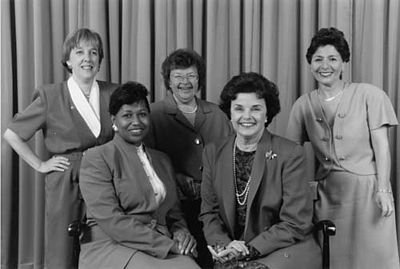
Twenty years ago, I signed up as a volunteer for a U.S. senatorial campaign in Pennsylvania. The candidate was a woman, and that year was dubbed "The Year of the Woman" in politics.
I know we don't talk about political positions in this blog (always a minefield), but all of us regular bloggers are women, most of the protagonists we write are women, and the majority of our readers are women, so I hope I may speak about women and politics in general terms.
1992 was a special year in politics, one in which we believed that the status quo might actually be changing, and we were going to be part of it. I had only dabbled in political activities before that—typing envelopes in high school, handing out candidate flyers at the old Boston Garden in college. I'm not sure I held any strong political convictions then. Early on I tried to adopt my parents' party allegiance, but that never quite took (and they more or less switched parties by the end of their lives anyway). I didn't join the 1992 campaign out of any idealogical position. Mostly I was curious to see what a campaign looked like from the inside, since every four years (or less) campaigns take over a large part of our news.
So I showed up and was put to work, and before long I was managing the entire data entry process, and getting paid for it. In the few months leading up to the election, I input 60,000 contributions from 40,000 individual donors (and ended up with carpal tunnel syndrome, no surprise). In case you've never been part of a campaign, it really is thrown together from one or two paid consultants and a whole lot of young, eager, enthusiastic volunteers who will do just about anything—drive people around, make endless phone calls, fill out the crowd at events and rallies.
In this case the core staff numbered around twenty people. Maybe. This was a statewide campaign that drew some national attention, and a bunch of kids in a shabby rented office were running the show. Heck, I was one of the oldest workers there, and I was the stuffy one, with a husband and child and a house in the suburbs.
Without question, it was the most fun I've had in my adult life. I loved it. I met all sorts of people, both politicians and celebrities, whose names you'd recognize. I got to be in a commercial, as part of the crowd (I still have the videotape). There were breathtaking highs and lows, and we celebrated every success, no matter how small.
Our candidate lost. Not because of incompetence or even lack of funds, but because we didn't want to play some of the long-established political games that might have pushed our candidate over the top. We had nothing to apologize for. Some Internet sources such as Wikipedia claim our candidate lost because of inexperience. Yes, she was new to politics, and goodness knows the staff was. But we thought what we were doing was important and we worked our butts off.
So here we are, twenty years later. Has anything changed? The public flaps between opposing candidates and parties over the past few weeks—about women/mothers working, about the right to choose, and more—make me wonder if we're moving backwards, not forwards. We might have thought that these were issues that were settled a generation ago, but here they are again, striking nerves on both sides of the aisle.
How far have we come? Not far enough. I still believe that government would run more smoothly if there were more women involved.
P.S. If you want a real sense of what the behind-the-scenes feeling was in a campaign, Primary Colors (by Anonymous/Joe Klein, 1996) captures it well.
Twenty years ago, I signed up as a volunteer for a U.S. senatorial campaign in Pennsylvania. The candidate was a woman, and that year was dubbed "The Year of the Woman" in politics.
I know we don't talk about political positions in this blog (always a minefield), but all of us regular bloggers are women, most of the protagonists we write are women, and the majority of our readers are women, so I hope I may speak about women and politics in general terms.
1992 was a special year in politics, one in which we believed that the status quo might actually be changing, and we were going to be part of it. I had only dabbled in political activities before that—typing envelopes in high school, handing out candidate flyers at the old Boston Garden in college. I'm not sure I held any strong political convictions then. Early on I tried to adopt my parents' party allegiance, but that never quite took (and they more or less switched parties by the end of their lives anyway). I didn't join the 1992 campaign out of any idealogical position. Mostly I was curious to see what a campaign looked like from the inside, since every four years (or less) campaigns take over a large part of our news.
So I showed up and was put to work, and before long I was managing the entire data entry process, and getting paid for it. In the few months leading up to the election, I input 60,000 contributions from 40,000 individual donors (and ended up with carpal tunnel syndrome, no surprise). In case you've never been part of a campaign, it really is thrown together from one or two paid consultants and a whole lot of young, eager, enthusiastic volunteers who will do just about anything—drive people around, make endless phone calls, fill out the crowd at events and rallies.
In this case the core staff numbered around twenty people. Maybe. This was a statewide campaign that drew some national attention, and a bunch of kids in a shabby rented office were running the show. Heck, I was one of the oldest workers there, and I was the stuffy one, with a husband and child and a house in the suburbs.
Without question, it was the most fun I've had in my adult life. I loved it. I met all sorts of people, both politicians and celebrities, whose names you'd recognize. I got to be in a commercial, as part of the crowd (I still have the videotape). There were breathtaking highs and lows, and we celebrated every success, no matter how small.
Our candidate lost. Not because of incompetence or even lack of funds, but because we didn't want to play some of the long-established political games that might have pushed our candidate over the top. We had nothing to apologize for. Some Internet sources such as Wikipedia claim our candidate lost because of inexperience. Yes, she was new to politics, and goodness knows the staff was. But we thought what we were doing was important and we worked our butts off.
So here we are, twenty years later. Has anything changed? The public flaps between opposing candidates and parties over the past few weeks—about women/mothers working, about the right to choose, and more—make me wonder if we're moving backwards, not forwards. We might have thought that these were issues that were settled a generation ago, but here they are again, striking nerves on both sides of the aisle.
How far have we come? Not far enough. I still believe that government would run more smoothly if there were more women involved.
P.S. If you want a real sense of what the behind-the-scenes feeling was in a campaign, Primary Colors (by Anonymous/Joe Klein, 1996) captures it well.
Thursday, May 3, 2012
Outrageous Older Woman
Liz Zelvin
All my life I’ve been what a friend calls a “Renaissance soul” (nonsexist language for what used to be “Renaissance man”): interested in a lot of different subjects and activities and moving them around on the metaphoric stove from back to front burner and front to back as life has provided and removed opportunities. I’ve played a lot of different roles. At the moment, I’m a mystery writer, therapist, and singer-songwriter with a new book and a CD out. I’ve worn the writer hat from the age of seven, but the music hat is almost as venerable, and the release of my album, Outrageous Older Woman, the realization of a lifelong dream.
As the bio on my music website tells my story (very different from my story as a writer and my mental health professional c.v.), I spent my childhood singing along on songs as diverse as morbid traditional murder ballads, old union and Spanish Civil War songs, and the gloriously sentimental harmonies of Girl Scout campfire songs. After a few uninspired years of piano lessons and a short career as a cellist in junior high and high school, I learned to play guitar at the age of thirteen and carried one with me everywhere for the next couple of decades. I wrote a song or two in college during the Sixties and several more as a Peace Corps volunteer in West Africa. I wrote and performed more songs while publishing two books of poetry and launching a midlife career as a psychotherapist and addiction treatment professional. For a while, I put music on the back burner, but then I encountered a trio of musical mentors whose influence and support helped extend my reach as both songwriter and vocalist. Through them, I had the pleasure of jamming with quite a few accomplished musicians and singers. While honing my skills as a songwriter, I realized that in terms of performance, happiness was having great backup.
Now, there’s a difference between mystery writing and making music. It takes a village to turn a manuscript into a book and send it out into the world. But the creation and perfecting of a mystery is a lonely process compared with a song’s journey. I wrote just about all of my more recent songs with the stimulus of a musical community. One of the mentors I mentioned was contemporary folk legend Jimmie Dale Gilmore, whose songwriting workshops I attended for several years at Omega, a New Age intentional community (or “dude ranch for space cadets,” as one of my characters calls its fictional incarnation in a so-far-unpublished novella).
Jimmie believes that the collaborative process mimics the creative process. Or as he put it, when you write alone, the voices saying, “That’s brilliant!” “No, that’s stupid!” are inside your head; when you write with others, your collaborators say the same things. The group songwriting sparked individual songwriting, with music as well as lyrics springing up from that same mysterious inner place as the characters that talk in the fiction writer’s head. And musicians, whether or not they are also writers, spend a lot of time making music. (I wish I could say that writers spend their time together telling stories. But they don’t—unless it’s stories about their struggles with agents, editors, and the literary marketplace.)
When I wanted the album to take my songs beyond the limitations of my singing voice and skill on the guitar, I was able to add the gifts of amazingly accomplished instrumentalists and harmony vocalists track by track: three more guitars in a wide range of styles; bass; keyboards, through the magic of digital technology, sounding at times like a concert grand, a honky tonk piano, accordion, organ, concertina, harp, tuba, and sitar; fiddle, cello, and banjo; clarinet, flute, and penny whistle; and drums and percussion. You’ll hear a klezmer band, a gospel choir, and a crowd of 100,000 at a demonstration, even though my co-producer and I never had more than one other person in the recording studio with us. (The sole exception is the klezmer song, for which our keyboard player brought along his exceptionally talented 16-year-old son to provide a mellow and witty clarinet track.)
I can’t tell you what a kick I got out of it when, late in the process of editing what we’d recorded, my co-producer and recording engineer started referring to the existing tracks as “the band.” (“Do you want to solo your vocal track or play it with the band?”) It would be heavenly to perform live with all ten of them together, instrumentalists and singers. It won’t happen, but I will have two of them along when I perform live in New York City on May 19 (You’re invited, details on my music website at lizzelvin.com. Two musicians: guitar, banjo, flute, fiddle, piano, and vocal harmonies.) But you can hear them all yourself. Listen to previews of all the songs. Better yet, buy the CD or download the album in mp3 format. Happy listening!
All my life I’ve been what a friend calls a “Renaissance soul” (nonsexist language for what used to be “Renaissance man”): interested in a lot of different subjects and activities and moving them around on the metaphoric stove from back to front burner and front to back as life has provided and removed opportunities. I’ve played a lot of different roles. At the moment, I’m a mystery writer, therapist, and singer-songwriter with a new book and a CD out. I’ve worn the writer hat from the age of seven, but the music hat is almost as venerable, and the release of my album, Outrageous Older Woman, the realization of a lifelong dream.
As the bio on my music website tells my story (very different from my story as a writer and my mental health professional c.v.), I spent my childhood singing along on songs as diverse as morbid traditional murder ballads, old union and Spanish Civil War songs, and the gloriously sentimental harmonies of Girl Scout campfire songs. After a few uninspired years of piano lessons and a short career as a cellist in junior high and high school, I learned to play guitar at the age of thirteen and carried one with me everywhere for the next couple of decades. I wrote a song or two in college during the Sixties and several more as a Peace Corps volunteer in West Africa. I wrote and performed more songs while publishing two books of poetry and launching a midlife career as a psychotherapist and addiction treatment professional. For a while, I put music on the back burner, but then I encountered a trio of musical mentors whose influence and support helped extend my reach as both songwriter and vocalist. Through them, I had the pleasure of jamming with quite a few accomplished musicians and singers. While honing my skills as a songwriter, I realized that in terms of performance, happiness was having great backup.
Now, there’s a difference between mystery writing and making music. It takes a village to turn a manuscript into a book and send it out into the world. But the creation and perfecting of a mystery is a lonely process compared with a song’s journey. I wrote just about all of my more recent songs with the stimulus of a musical community. One of the mentors I mentioned was contemporary folk legend Jimmie Dale Gilmore, whose songwriting workshops I attended for several years at Omega, a New Age intentional community (or “dude ranch for space cadets,” as one of my characters calls its fictional incarnation in a so-far-unpublished novella).
Jimmie believes that the collaborative process mimics the creative process. Or as he put it, when you write alone, the voices saying, “That’s brilliant!” “No, that’s stupid!” are inside your head; when you write with others, your collaborators say the same things. The group songwriting sparked individual songwriting, with music as well as lyrics springing up from that same mysterious inner place as the characters that talk in the fiction writer’s head. And musicians, whether or not they are also writers, spend a lot of time making music. (I wish I could say that writers spend their time together telling stories. But they don’t—unless it’s stories about their struggles with agents, editors, and the literary marketplace.)
When I wanted the album to take my songs beyond the limitations of my singing voice and skill on the guitar, I was able to add the gifts of amazingly accomplished instrumentalists and harmony vocalists track by track: three more guitars in a wide range of styles; bass; keyboards, through the magic of digital technology, sounding at times like a concert grand, a honky tonk piano, accordion, organ, concertina, harp, tuba, and sitar; fiddle, cello, and banjo; clarinet, flute, and penny whistle; and drums and percussion. You’ll hear a klezmer band, a gospel choir, and a crowd of 100,000 at a demonstration, even though my co-producer and I never had more than one other person in the recording studio with us. (The sole exception is the klezmer song, for which our keyboard player brought along his exceptionally talented 16-year-old son to provide a mellow and witty clarinet track.)
I can’t tell you what a kick I got out of it when, late in the process of editing what we’d recorded, my co-producer and recording engineer started referring to the existing tracks as “the band.” (“Do you want to solo your vocal track or play it with the band?”) It would be heavenly to perform live with all ten of them together, instrumentalists and singers. It won’t happen, but I will have two of them along when I perform live in New York City on May 19 (You’re invited, details on my music website at lizzelvin.com. Two musicians: guitar, banjo, flute, fiddle, piano, and vocal harmonies.) But you can hear them all yourself. Listen to previews of all the songs. Better yet, buy the CD or download the album in mp3 format. Happy listening!
Labels:
Liz Zelvin,
Outrageous Older Woman,
urban folk music
Wednesday, May 2, 2012
From Limbo with Love
Today's guest blogger, Jon Jefferson, is the “Jefferson” half of the crime fiction duo Jefferson Bass. Working in collaboration with Dr. Bill Bass, the forensic anthropologist who founded the Body Farm at the University of Tennessee, Jon writes the bestselling series of Body Farm novels. The latest, The Inquisitor's Key, comes out May 8.
| Jon Jefferson (left) and Dr. Bill Bass at the gate of the Body Farm. (Photo by Erik Bledsoe.) |
by Jon Jefferson
A few years ago I complained to a friend – an old, wise friend – that I felt myself at a crossroads, unsure which direction to head. I was utterly in limbo, I told him – and I really hated the limbo. He listened, then he was quiet for a minute; finally he said, “You’re in the place of not-knowing, and you need to hang out there for awhile.”
I said, “But I want to know where I’m going; what the next point on the journey is.” He smiled and said something about trusting my intuition to guide me there, even if I didn’t know where “there” was until I arrived.
I’m reminded of this as I look back on The Inquisitor’s Key: a book whose seeds were planted in my mind in the 1990s, although I didn’t notice them sprouting out my ears until a year and a half ago.
I said, “But I want to know where I’m going; what the next point on the journey is.” He smiled and said something about trusting my intuition to guide me there, even if I didn’t know where “there” was until I arrived.
I’m reminded of this as I look back on The Inquisitor’s Key: a book whose seeds were planted in my mind in the 1990s, although I didn’t notice them sprouting out my ears until a year and a half ago.
The year was 1998. I’d recently started writing and producing television documentaries (a career for which I’d had approximately thirty seconds of training), and I’d just finishing shooting for a week in Rome and at the Vatican, for a two-hour Arts & Entertainment Special called “The Vatican Revealed.” (Several bits of trivia: That show—which A&E trotted out and rebroadcast for years, every Easter, and every time Pope John Paul II looked likely to die—is still available for purchase on Amazon; one Amazon customer has grumbled that the show is obviously the work of a brainwashed Vatican mouthpiece; another has complained that it was clearly made by someone with a deep bias against the Vatican… But I digress.) On the way home from shooting in Italy, we made a two-day detour, almost as an afterthought, to Avignon, France, a small city in Provence where a series of French popes reigned in the 1300s.
When I arrived in Avignon – a small-town boy from Protestant-prone Alabama – I was blown away. The city itself was lovely, a medieval jewel-box tucked into a loop of the Rhone River, but the most astonishing thing was the Palace of the Popes – an immense, impregnable fortress, protected by massive towers and soaring battlements. This would make a cool location for a movie, I thought vaguely. But that vague thought was as far as my thinking went … or so I thought.
Before long I found myself writing two stories about Avignon – a 21st-century murder and a 13th-century mystery – linked by old bones and by timeless evil: the lust for power, masquerading as piety and religious fervor.
When I finished writing The Inquisitor’s Key, I grieved. The time I spent hanging out in Avignon – Avignon on the Rhone, and Avignon in my mind – was the richest, most intense period of writerly immersion I’ve ever had. I miss the place, and I especially miss the medieval characters – the mooning and self-righteous Petrarch, his beloved and unattainable Laura, the earthy painter Simone Martini, even the heretic-obsessed inquisitor, Jacques Fournier.
What’s next, now that this one’s done? I wish I knew. I’m at a crossroads, hanging out, unsure which direction to head. I’m utterly in limbo, and I really hate being in ...
Oh.
Oops.
Did I mention that I love the journey?
For more on Jefferson Bass, LIKE them on Facebook, read their blog, follow them on Twitter, and visit their website. Also available: a 99-cent e-story prequel to The Inquisitor’s Key entitled Madonna & Corpse.
Subscribe to:
Posts (Atom)