Tuesday, June 7, 2011

Yes, No, and Maybe

Sharon Wildwind

As I write this, the sun is shining on Victoria harbor, the flowers are blooming, and the wonderful Bloody Words 2011 convention has come to an end. I had a marvelous time, met loads of people, and collected tons of new ideas, but since I have to leave the hotel soon to catch a plane and will get home late tonight, I’ll share just a mini-report right now. More next week.

This is from a panel on How to Maintain Pacing in Suspense and Comedy. The question posed to the panelists was, “Does humor have any place when the story reaches a climax?”

Yes, it does. It humanizes a very difficult situation and can add depth and texture to the climax.
~Don Hauka, reporter and author of the Mister Jinnah series.

Absolutely not. Crisis and the climax is all about tension and humor defuses tension.
~Phyllis Smallman, author of Sherri Travis series.

Maybe. If humor has been a part of the character’s personality all of the rest of the way through the book, it’s unnatural if the humor disappears in the crisis moment. The humor may change, diminish, become darker or brittle, but it shouldn’t go away.
~Anthony Bidulka, author of the Russell Quaint series.

Which just goes to show there are very few absolute answers in writing.
-----
Quote for the week:
Every trip you take should produce a minimum of five written pieces:
a. A memoir
b. A character sketch
c. A poem
d. A travel piece
e. A piece of fiction, even if it’s only a few paragraphs long
~Verna Driesbach, author, editor and literary agent

(Looks like I have my work cut out for me after this trip.)

Monday, June 6, 2011

Writing A Ghostly Nun Tale

by Julia Buckley
From the time I entered first grade to the day I graduated from high school, I benefitted from the teaching of Dominican Sisters. I suppose it's no surprise, then, that the second book in my Madeline Mann series, LOVELY, DARK and DEEP, is heavily populated with nuns.

The premise of the book: Madeline is approached by her former high school English teacher, Sister Moira McShane, about the death of a nun named Sister Joanna. Moira fears that Joanna's death--ten years in the past and deemed an accident--was foul play, but her only evidences of this are her own troubling dreams. Madeline, skeptical in her faith and about this case, takes it on merely as a favor to her beloved teacher. In the ensuing investigation, she finds out that even nuns have secrets, and it becomes her task to expose those secrets . . . and a murderer.

So why did I write about nuns? I suppose they are very much a part of my consciousness, and certainly they shaped who I am today. But as Madeline points out in the book, women religious are often misunderstood, and what people don't understand, they turn into stereotypes or caricatures. Yet the nuns Madeline encounters are women of faith and humor; they are regular human beings who are willing to live their beliefs in a structured way.

And their numbers are dwindling. Sr. Sandra M. Schneiders, IHM, wrote that "It is true that the numbers of U.S. women religious declined precipitously, by tens of thousands, from the highpoint (at least 120,000) in the mid-sixties to something around 60,000 today. This was due principally to two factors, not identical, namely, the sharp drop-off in numbers entering religious life and a major exodus of professed religious from the life. These phenomena were largely simultaneous which leads many people to fail to distinguish between them."

I went to a parish school in the 1970s, so I was still enjoying the benefits of a large and diverse population of nuns who had many talents to share. What did they give me?

First, a fine education. The women who taught me were professionals who possessed vast knowledge about their fields.

Second, a belief in excellence. These women did not settle for second best, and that has influenced the way I see the world.

Third, an open attitude toward faith. The nuns who taught me theology weren't horrified by students who questioned Catholic doctrine or vocalized their doubts. They wanted their students to think for themselves.

Fourth, a full investment of themselves in the classroom. These were energetic, joyful, intelligent women who wanted to share their knowledge of Latin, English, math, science, theology, chorus. They were women who believed in the pillars of Dominican life, especially prayer, study and community.

So it's not surprising, I suppose, that Dominican sisters would find their way into my writing.

And if Madeline's encounter with the sisters is something that interests you, you can find LOVELY, DARK and DEEP on Nook and Kindle. ;)

Saturday, June 4, 2011

This is My Tribe

by Sofie Kelly (aka Darlene Ryan)
Author of the Magical Cats Mysteries


Writers work alone. We create worlds. We kill. We make love spark and desire simmer. We live, much of the time, in a make-believe world with people who don’t exist outside of our heads and our laptops, and the real people in our lives shake their heads and wonder if we’re deluded. Or delusional.

But for the last week I’ve been taking an online writing workshop, and I’ve been surrounded by a community that doesn’t think it’s odd to talk out loud about imaginary people. Or to them. No one asks, “Why don’t you write something like Twilight?” 

Several years ago I sat with another group of writers and heard poet and novelist Sue Goyette say, “We are your tribe. We understand.”

I have found my tribe again in an electronic gathering of like-minded people. In our online class we get giddy over a plot twist or a well-crafted paragraph. We throw ideas at one another, posts crossing in the ether until a suggestion becomes a few words from one person, a few from someone else. “Turn the princess into a vampire witch on a quest to find Elvis in the lost city of Atlantis.”

“Send me your address, I found that book we were talking about yesterday,” someone emails. No one ever complains, “Mom, we have no toilet paper again.”

Writers write and when we aren’t writing, some part of us is always watching, always plotting, no matter what’s happening to us or around us. No matter how sad, how silly, how bizarre, a little voice in our heads is thinking, How can I use this? We are crows. We see shiny pieces of other people’s lives and we reach for them. In our real lives we hear, “Don’t put this in a book.” In class a dozen people type, “You have to write about this.”

This is my tribe. People who sit too long at stop signs searching for the right words to describe a sliver of crescent moon that seems to be teetering on a roof edge. People who fall on a patch of sidewalk ice and ask the paramedic for a pencil and a piece of paper to scribble down the sensations.

In the real world this past week, dust bunnies have met, courted and spawned babies. In the real world there are enough crumbs under the kitchen table to make a sandwich. And in a few more days we’ll be ready to go back to the real world, to hunt down the dust bunnies and sweep up the crumbs. We’re part of the tribe now and we’ll take that sense of community, of encouragement back to the real world. Because the real world is where all the stories begin. Stories about love, hate, despair and what really happened to a dozen double rolls of toilet paper.

***********************
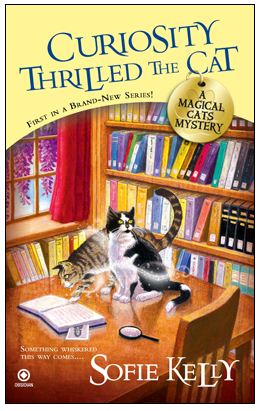
Sofie Kelly is the pseudonym of young adult writer and mixed-media artist, Darlene Ryan. Her first Magical Cats Mystery, Curiosity Thrilled the Cat, landed on the N.Y. Times bestseller list. Sofie/Darlene lives on the east coast with her husband and daughter. In her spare time she practices Wu style tai chi and likes to prowl around thrift stores. And she admits to having a small crush on Matt Lauer. Visit her website at www.sofiekelly.com.

Friday, June 3, 2011

Promotion Redux


by Sheila Connolly


I promise I'll stop obsessing about this soon, but with two books coming out in the next two months, promotion is very much on my mind.
The following was part of an email I received this week from an organization I subscribe to on line, and the header line included "Learn Essential Marketing Tools."  I was invited to participate in a series of workshops where I would learn how to:

--Develop a branding concept
--Develop an overall marketing campaign
--Understand and decide what marketing tools (web, print, etc.) best attract customers
--Learn how to plan and create the framework for your website
--Plan and create a website


All of this sounded very familiar, and I've been hearing it from publishers, agents and colleagues for years.  So why am I repeating it here?  Because this was targeted at farmers.  The email announcement came from SEMAP, the Southeastern Massachusetts Agricultural Partnership.

Yes, the workshops are all about how to market your farm business--just add "for your farm" at the end of each of the above items on the list.

And, believe it or not, this put some things in perspective for me.  Think about it:  electronic media have erased the boundaries between business sectors, and now the same strategies can be applied to mysteries and organic tomatoes.  It's kind of humbling.

But it's also an affirmation of the power of the Internet, if you know how to use it.  Think for a moment of any of the recent examples of civil unrest in various countries.  In an earlier, simpler day, despotic leaders could simply have shut down the radio and television stations and the newspaper (if they didn't already control them outright), and the general population would have had only limited knowledge of what was going on.  Now everyone seems to have a cell phone with Internet access and can post minute-by-minute reports on violence, with pictures and videos.  It's much harder to stifle a revolution these days.

Or in another case, just this past week in South Boston, close to a thousand teenagers congregated at a local beach, and--no surprise, since it was one of the first nice warm days of the year and no doubt more than one illicit substance was involved--violence broke out.  Did all these young people just happen to show up?  No.  They used Twitter and Facebook to draw people to the beach.

And then there's that hapless Congressman who's gotten into hot water about a nude photo that was sent from his Twitter account to someone inappropriate.  I don't know who was guilty of what, but listening to him sputter on camera, it was abundantly clear that he had little understanding of the impact of what had happened. (Bet you have a young aide on your staff who can explain it to you!)


It's an electronic world, and people have become accustomed to instant information.  My Luddite husband can barely dial his cellphone, but last week he spent eight hours driving to a conference with a bunch of colleagues, and any time a question came up, one or another of them would say, "let me look that up on my phone."  This isn't a novelty any more, this is the norm.


What's a writer to do?  We have to embrace ebooks, for one--and that's not easy, because the publishing universe is changing weekly, and even the major publishers are scrambling to keep up, frantically revising contract terms.  But we as individuals can't ignore the potential and the power of the Internet, or we'll be left in the dust.

Thursday, June 2, 2011

Books We Love, Books We Recommend

Elizabeth Zelvin

The Malice Domestic convention represents the biggest gathering of avid mystery readers (excluding Bouchercon as drawing lovers of crime fiction and thrillers as well). Malicegoers have a fanatical loyalty to their favorite authors and series characters and an encyclopedic knowledge of the books they’re read (and in many cases, reread over and over). It’s not guaranteed that attendees will have conversations about these books, apart from those of authors who are present and those nominated for the Agatha awards (or the Edgars, which MWA announces just as Malice begins). But it does happen. I had two such conversations during this year’s Malice: one with the old friend with whom I stayed (located conveniently two and a half miles down the road from the convention hotel in Bethesda, MD) and the other with the gentleman who sat on my left during the Agathas banquet, Steve Steinbock, recently appointed book reviewer for Ellery Queen’s Mystery Magazine.

My friend and her husband are mystery readers, but they aren’t connected to the mystery community, so I had the fun of recommending writers they didn’t know, once they’d told me enough about their tastes to get a sense of whose books they might like. They read James Patterson but find his work “a little too formulaic” and his characters lacking in depth. (They knew nothing of Patterson’s team approach to writing.) They enjoy Robert B. Parker because the formula is redeemed by witty dialogue and characters they have become attached to. (They were surprised to hear that many readers don’t like Susan Silverman.) They don’t mind the gore in Jonathan Kellerman’s books, but think John Sandford goes too far. They had reservations about Linda Fairstein on the counts of characterization and excessive detail in the passages on police procedure.

Between the dealers’ room at Malice and the bag full of books given out to attendees, I was able to give my hosts books I knew they would enjoy along with the fun of making recommendations. Felony & Mayhem Press was selling some of my very favorite traditionals: I bought Janet Neel’s Death’s Bright Angel for them—a police procedural with sophisticated and intelligent characters the reader falls in love with—and Peter Dickinson’s Sleep and His Brother, which I had recently been thinking of and wishing I could reread, for myself. The husband is interested in the World War II era, so he got two excellent books from the goodie bag that I’ve already read: James R. Benn’s Billy Boyle and Charles Todd’s The Red Door. I can’t wait to send my friend a list of series authors she can put on her Kindle, including Margaret Maron, Laurie R. King, and Donna Leon, all of whom I’m sure she’ll love. I think the husband will enjoy Jan Burke, Reginald Hill, and Cynthia Harrod-Eagles.

Steve Steinbock, whom I first met in the bar at Bouchercon a couple of years ago, is a kindred spirit who loves many of the same books I do. He agreed with (or at least let me rant on about) my theory that the middle ground between the heirs of Agatha Christie and the heirs of Raymond Chandler is occupied by the heirs of Dorothy L. Sayers, who introduced the character-driven novel to mysteries of the Golden Age. This goes largely unacknowledged in the perennial cozy vs hardboiled debate, although imho the descendants of Sayers include some of the most extraordinary writers of traditional mysteries, including Maron, King, Hill, and Julia Spencer-Fleming, as well as (arguably) Laura Lippman and S.J. Rozan (usually considered crime fiction writers) and Nancy Pickard and Charlaine Harris (usually considered cozy writers). Steve and I had a grand time talking about Manning Coles’s Tommy Hambledon spy novels. I was able to recommend to him a writer he didn’t know, Michael Gruber, whose The Book of Air and Shadows I consider the perfect thriller (plot, characterization, listen-to-this language, and even humor) as well as a brilliant World War II era suspense novel he didn’t know, the late Ariana Franklin’s City of Shadows. I also recommended Peter Dickinson's superb King and Joker, a refreshing alternative-history view of British royalty (and a propos as the royal wedding competed with Malice itself).

What mysteries do you love? Which authors do you recommend?

Wednesday, June 1, 2011

Does online book shopping kill impulse buying?

Sandra Parshall

Anybody who likes to hang out in bookstores has discovered a new favorite writer by browsing and impulsively purchasing a book that looked intriguing. But when we shop online because our local bookstore has closed or we lack time for leisurely trawls through the aisles, do we buy fewer books on impulse?


A new study by Bowker and Publishers Weekly indicates that we do. According to the 2010-2011 U.S. Book Consumer Demographics & Buying Behaviors Annual Review, 44% of respondents said they went online to buy a specific book, while only 11% said they made an online book purchase on impulse. By contrast, 26% of people who browsed through physical books in a store said they made an impulse buy.

Results were consistent across all trade segments and all categories of customers: browsing in a store leads to far more impulse purchases than buying online. As Publishers Weekly points out, understanding the way people buy online has become a major concern in the industry because in 2010 online retailers surpassed the chain bookstores in sales for the first time, taking in 30% of the money spent on books. Online retailing is now the single largest outlet for books. When all types of brick-and-mortar bookstores are combined, they still outsell online merchants, but PW expects that to change this year as Borders fades and Amazon continues to grow.

The big worry is that as readers shift their book-buying online and go in search of specific titles, sales will become even more lopsided in favor of well-known authors. The challenge for online retailers is to find a way to create the browsing experience on an electronic screen and allow readers to discover new-to-them authors.

Meanwhile, bookstores in Canada are hoping to get a cut of e-book revenue by making it easy for customers to browse through and purchase electronic books in a store setting. A Calgary company called Enthrill is on the verge of offering cards that display book covers and contain electronic access codes. The cards are thin and take up little shelf room, but they’re touted as a way to give the customer the “tangible element” that is missing from e-books. They’re also an easy way to purchase e-books as gifts. Small specialty stores that can’t afford to stock a variety of printed books can expand their offerings with the e-cards. Enthrill will make the cards available in up to 150 stores this summer in a test run with a limited number of titles in a broad spectrum of genres. A similar approach with the Zondervan/HarperCollins Symptio card was a flop – and ended just before the e-book boom took hold. Enthrill believes its book cards are coming on the market at the perfect time.

So the online merchants have to be more like brick-and-mortar stores to capture the profitable impulse buyers, while the stores want to find a way to profit from the e-book revolution.

Anybody brave enough to guess what bookselling – and buying – will look like 10 years from now?

Tuesday, May 31, 2011

Obsession

Sharon Wildwind

Whether you’re writing from Debra Dixon’s goal, motivation and conflict idea, Donald Maass’ raising the stakes, or other conflict-development theories, if you want a story to have depth and interest, give your protagonists and villains obsessions. Some characters may appear to have a passion rather than an obsession, but that’s just a nicer-sounding word for the same thing.

Being obsessed with marrying England’s Prince Harry would likely be thought a bad thing, especially by Prince Harry; being passionate about ending homelessness, a good thing. Watch those passions, however. When a good idea gets in the way of a normal, balanced life, it turned into an obsession. Remember that as writers, we want to stress, stress, stress our characters so passions that get out of hand can be a good thing.

Passion or obsession, the character can’t get away from the one grand and glorious thing they believe they must do with their lives. Lord Peter Whimsey became obsessed with proving Harriet Vane innocent of murder. Harriet, for her part, was obsessed with maintaining her independence. Those two competing obsessions carried through several books until both of them, passions spent, fell into each others arms.

There are a lot of theories about why obsessions/passions develop. For character development, I favor the traumatic event in the past situation.
1. Something happened to the character that planted the seeds of obsession or passion. Strangely enough, with Peter and Harriet, the sticking point was likely money. Peter had lots of it, but even all of that wealth could not protect Harriet from going to the gallows. He had to give more than money to save her. For Harriet, having to earn her own living after her father died set up that streak of independence.
2. It was an event with emotional significance and it occurred at a time when the character was either truly helpless or thought that they were helpless.
3. Something prevented them from getting counseling, medication, understanding, perspective, or hope after the incident.
4. Something happened to reinforce the victim’s story. The victim’s story says they did this to me. I did nothing/could do nothing to prevent this from happening.

Victim characters are often not very interesting. They tend to whine and that gets tedious. When Peter and Harriet meet, both have moved through the victim’s story to the survivor’s story, though Harriet has a bit more of a victim about her. Her line is that she allowed Philip Boyes to set the parameters of their relationship, that she was a fool to do so, and that her being brought to trial just might be what she deserves for being so stupid.

The survivor’s story says, this thing happened. While I couldn’t prevent it, I did these things to survive. Peter knows what he did to survive the Great War, and more important, what he is doing to survive being a younger son in one of the richest families in England. That bally-ho, fatuous man-about-town image is his survivor’s story, constructed so that people will let him alone.

Both of their survivors’ stories have crystalized around them. What makes their relationship work is that each can see in the other something that other people miss. They challenge one another to come out of their glass prison and be real, true, and vulnerable. Doing this takes time. It’s not a straight shot from survivor to thriver.

Remember that stress, stress, stress? Good fiction is one step forward, and two steps back. Whatever the character risks has to turn on them. This way, when they take a risk again, there has to be a whole lot more motivation, courage, hope, or love pushing them to take that second chance. And yet more for the third time, and so on until the reader feels that there is no possible way that the character will take that final chance, the one that brings them out of being a survivor and into being a thriver.

The thriver’s story says, “I wouldn’t wish what happened to me on anyone, but I’m a better person because I’ve come through the experience and participated in my own healing.”

That’s a great outcome for heroes and heroines, but alas, life never works out so well for the villain. Fortunately for the writer, a good villain remain stuck in the victim’s story. Life has been done to him. He has no way to participate in his own rescue and that warps his view of the world. Think of heroic characters as moving forward and villains as repeating a circle over and over, only the circle gets deeper and harder to move out of each time.

Want character development in one question? That question is What is their obsession?

If you’re interested in knowing more about victims’, survivors’ and thrivers’ stories, see Dr. Rob Voyle’s Book, Restoring Hope.

-----
Quote for the week
Your biggest problems and your worst obsessions contain the seeds of your own growth and development.
~Sara Halprin, writer and process work therapist

Monday, May 30, 2011

Young Love, Righteous Revenge, and The Power of the Personal Essay

by Julia Buckley

My husband and I were married twenty-three years ago this weekend, on the Sunday of Memorial Day weekend. We are rather surprised to find ourselves at this milestone, since we like to think of ourselves as still youthful. But time doesn't lie, and neither do our growing children, so here we are.

In honor of the day, I'll tell the rather odd story of how Jeff and I met.

In 1986 I was a junior in college and dating a guy named Bob. My boyfriend and I had been having some rough times, mainly because I think we were realizing we weren't "meant to be," if you believe in that sort of thing. So it was only partly surprising when Bob, who attended ISU, called me in Indiana and said that the formal dance he'd agreed to attend with me--the one for which I'd already purchased expensive tickets and persuaded my mom to alter an old prom dress--was something he could not now attend. He had to work, he told me.

In a cold voice I told Bob that would be just fine. And then I plotted my revenge. I would find a guy--any guy--to go to that dance with me, and I would have fun. I was thinking, at that point, of just going to a random store and approaching all males with my dance proposition, but then I had a brainstorm. My brother, eight years my elder, worked in Chicago in a big glamorous office building (or so I thought at age 20). He had often told me tales of his humorous co-workers. Surely one of them could be persuaded to go out with a cute college girl?

So I called my big brother and told him of my idea. He sounded skeptical. "Uh--I don't really know," he said. "I guess I could ask Jeff Buckley."

"Sure! He sounds great," I said.

"He's very funny," my brother assured me. This, I assumed, was a euphemism for ugly, but I didn't care. I told Bill to go ahead and extend the invitation.

I called that evening to find out the result. "Is he going?" I asked.

"Uh--he might. He has a list of demands."

Pause. "A list of demands? Like . . . a terrorist?"

"You have to know Jeff's sense of humor," he said. And then he read me the demands, which Jeff had scrawled on a piece of paper in his terrible handwriting while he was supposed to be working. To be honest with you, I can't remember them all, but one of them was "You must refer to me as 'Bronco' for the entire evening" and another was "write a five-paragraph essay entitled 'Why I must be accompanied by Jeff.'"

I actually thought this was pretty funny, and I was an English major, so I tossed off the essay in no time and had it ready when Bill and Jeff arrived on the dance day (there was no e-mail then, and I didn't have time to mail it).

Jeff told me later that it was a longshot that he showed up at all; he regretted telling Bill he'd go out with his little sister (he'd been told I was funny, which he assumed was a euphemism for ugly), and was going to call in sick. However, he had so much respect for my brother (and still does) that he didn't want to disappoint him. So he made the one hour drive to my parents' house in the suburbs, then another hour-long drive, with Bill, to Valparaiso University, where we met in our cumbersome formal clothes. I have attached a photo which chronicles forever the awkwardness of our meeting (and the exchange of the essay). (It also shows that on my dorm room wall I had, inexplicably, a poster for CATS and a picture of the "Hey Vern" guy. Go figure.)

Anyway, Jeff and I hit it off quite well, and when he decided to kiss me later that same night, he prefaced it by saying, "Let's get this awkward moment out of the way." That made everything seem pretty inevitable, which I guess it was.

I never did call him Bronco, though. Maybe after forty years.

(Note: This is a slightly-altered version of an essay I wrote a few years ago on my twentieth anniversary).

Saturday, May 28, 2011

Writing Historically


When I was asked to be a permanent participant on this blog the answer was a resounding “yes!” The five ladies who trade off writing blog posts have established an amazing resource with heaps of good writing advice and information on the ever-changing publishing world. Being a part of that was a no-brainer. But I did point out that on my own website, blog, and on my character blog, I usually spend a lot of time thinking and talking about the Middle Ages. But since most of us on this blog are middle-aged, that was okay by them!

I write a series of medieval mysteries that have a darker bent than your Brother Cadfael type. I call them “Medieval Noir,” hardboiled detective fiction set in the Middle Ages with an ex-knight turned detective as my protagonist. Writing historically is not a challenge, it's part of the fun. Not only are you creating these interesting characters and their situations, but you get to put them into a very real world that you find endlessly fascinating!

When I first began writing historical fiction many years ago, I worried that I would get so wrapped up in the research I’d never get to the book itself. We call that “research rapture.” Well, those days are long gone. But I still enjoy the thrill of researching and discovering that great fist-punch-in-the-air moment when you find out something that will work perfectly for your story. I like to write my stories and characters as if they could have existed, as if they perhaps should have existed.

My hero is Crispin Guest and as I mentioned before, he is an ex-knight turned detective on the mean streets of fourteenth century London. And yes, there were ex-knights, degraded knights, as they called them, but none, as far as I know, ever became a detective (a job that was decidedly of my own fiction for this time period). Most of the degraded knights I came across were degraded right before they met a very ignoble and nasty end. So I had to come up with a plausible way for Crispin to have been degraded and survive so that he could re-invent himself as a medieval PI.

Research into the early court of King Richard II when my books are set gave me the answer. You see, Richard became king when he was ten years old. Can you imagine your own ten-year-old becoming king? This naturally came with its own set of problems. I don’t think “spoiled” really covers it. His reign started with great promise, but later, he was accused of favoring too many hangers on and generally making a hash of it.

Meanwhile, Richard’s uncle, the daunting duke of Lancaster, was the richest man in England and an indomitable warrior and experienced statesman. Parliament feared, and rightly so, that the duke would try to jump the line of succession and take the throne for himself and he made promise after promise that he would not do so. That didn’t stop the conspiracy theorists from hatching plots (of course, who’s to say that there weren’t any?)

So here’s where my fiction kicks into the historical facts. I made Crispin the duke’s protégé, had him raised in the duke’s household since he was seven years old, seeing the duke as a father figure. And so naturally Crispin throws in his lot with these conspirators, thinking that it is for the good of England. The conspirators are caught and all are condemned. Crispin is up for execution, too, but instead, the duke begs for his life. His life is granted but all else is taken from him: land, wealth, status. All that defines him. He’s thrust into the heart of London with nothing but the clothes on his back. Instant angst, instant chip on shoulder. Much can be done with his inability to blend into the lower classes when he clearly is not, and that, in his heart, he is and always will be a knight.

I love it when a plot comes together.

But now comes fleshing out the rest of the world. What are the people wearing? What are they eating and drinking? What are they eating and drinking on? Where do they sleep? What are the customs they encounter? What is the difference between the classes? What does London look like in 1385?

University libraries, archives on the internet, emails to people across the pond. These are the places I find all the bigger facts I need. For some of the smaller ones, I prefer a little hands-on approach. I have a book of medieval recipes from King Richard’s court and I’ve cooked my share of (small) feasts. I’ve brewed my own medieval ale, from preparing the grain and allowing it to sprout, to roasting it, to grinding it, to actually brewing it. I’ve made and worn the clothing. And I’ve collected the weaponry and know how to use it. Having a hands-on approach can give you a true appreciation for the experiences of medieval people.

One of the nifty facts I haven’t been able to use yet in my stories was something I uncovered about London. About how a lot of medieval men met their accidental deaths. It seems there was an inordinate number of men dying from falling out of windows. Naturally, I thought this bore more investigation. What I discovered was that, with a fair amount of alcohol involved, these men would get up in the middle of the night to accede to a call of nature. But instead of climbing down long staircases or rickety ladders, they would open the windows (which had no glass, just shutters), stand in the open window, and…well, misjudge. Talk about being caught dead with your pants down! It’s one of those facts I can’t wait to use.

Each fact that’s uncovered unfolds more plot points, more places for the characters to go. I utilize real figures from the Middle Ages. Without telling any spoilers, let me just say that some are very unusual characters indeed, a real case of truth being stranger than fiction. That’s the real joy of writing historically. Rather than limiting, I find it an endless cornucopia of fodder for my stories.

Friday, May 27, 2011

What is it worth to you?

by Sheila Connolly

I’m a genealogist in my so-called spare time, and recently I realized that while I hadn’t been paying attention, the Registries of Deeds in Massachusetts counties have been busy scanning their deeds (which means that in Plymouth they really do go back to 1620) and uploading them so they can be accessed online.  If you’ve ever done research using the originals, you know how challenging interpreting both the handwriting and the terminology can be, and print-outs used to be very expensive, so you’d spend a lot of time laboriously copying the relevant information and hoping you got it right.


Now you can go to each county and call up the electronic version through an online database.  For the earlier years you need to know the book and page number for the deed(s) you are looking for, but you probably already have that.  So they’re still working on the system—it’s not perfect yet, but for researchers like me it’s a huge step forward.


But (of course there’s a but), all counties do not approach this process in the same way.  I was lucky to strike gold in Hampshire County (where my Orchard Mysteries are set), which will let you read and print out images of the originals for free.  Since I’ve got a lot of ancestors out that way, this was wonderful for me.


But I live in Plymouth County, and I’m curious about the ancestors who lived here, as well as about the history of my house, so I next checked out my county’s system.  Uh-oh, they want money.  I guess they’re assuming that most users are involved in real estate, one way or another, so for them paying $30 a month to access deeds is simply a business expense that gets passed on during a land transaction.  Then I decided to check out Norfolk County, where I had still other relatives (they’re everywhere in this state, believe me).  Gulp:  they want an upfront subscription fee of $100 per year, plus a $1 per page printing fee, also prepaid.  All those lovely images of 18th and 19th century deeds, many of which I’ve never seen personally—how much are they worth to me?  That’s what I have to decide.


And, to get to the point (yes, I do have one), I realized that this is similar to the ebook business these days.  While the numbers of ebooks published, and the range and quantity of ereaders, have both grown exponentially over the past couple of years, the pricing model is still all over the place.  Speaking from my admittedly limited experience, at the high end we have Major Publisher ebooks, which cost the same as the paperback version, or maybe a dollar less.  Not a bargain, unless you (the reader) place an implicit value on instant gratification. 


Then you have a lot of people who are uploading books themselves.  These include well-established authors who happen to have a backlist that is long out of print.  Why not sell them on Amazon and make a little more from them?  In addition, there are established authors who have unpublished manuscripts that are not in the genre that is their bread and butter; now they can upload them themselves and promote them, with or without using a pen name, and make some money there (and we writers hate to waste a book!).  And finally you have the legions of writers who are tired of slogging through the agent-publisher morass and just want to get their book out there so they can tell all their friends and relatives. 


How do you put a price on these books?  That’s a business decision, or a marketing one—and many writers are ill-equipped to deal with pesky realities like that.  If you sell it for 99 cents, are you devaluing your work before it even goes live?  Is it arrogant to price it at the same level as a physical book?  Are you using the book as a teaser, hoping to hook readers and planning to raise the price on later offerings?  Where is the happy medium that allows you to look worthy but not greedy?


Barry Eisler announced to the world a couple of months ago that he was going to eliminate the middlemen and publish himself, although this week he’s cut a deal directly with Amazon’s new mystery imprint (is it an imprint if it’s not, well, printed?).  See how fast things are changing? But Eisler already has a solid group of followers.  At the same time there are plenty of eager authors who are loosing poorly edited and formatted works on the reading world, and doing themselves no favors.  If you paid $7 for a bad book, would you feel cheated?  Would you buy anything else written by that author, or has s/he blown their one and only chance?  Would you feel differently about a bad work if you had paid only 99 cents?


What is a book really worth?