

 Posts


Sharon Wildwind
How do readers latch on to characters?
When a reader begins a book, she has no idea which characters are important, and which are there to smooth we way into the story, but will never be seen again. She will file every character with the same diligence until she can figure out how important they are to the story. Here are some things that authors can do to help the reader find her way.
Introduce the character in media res; that is, smack dab in the middle of doing something doing something with a high physical and/or emotional content.
Give each character a unique name, so that the total character list contains a mixture of sounds, number of syllables, and ethnic origins.
Limit the number of names and titles referring to one character. For example, a character named William Smith, should not be referred to as William, Bill, Billy, Willy, Willy-Boy, Mr. Smith, the Boss, and Old Red-Face by different characters.
If there is more than one character sharing the same descriptive title—several doctors, or priests, or detectives—give each character a unique character sketch so that Father Jones won’t be confused with Father Rafael or Father Whitcombe.
Give each character unique ways of relating to the physical world. This includes their physical description, clothes, food, living spaces, possessions, and their relationship to each of these.
Unless dealing with a turning point, where a previously unknown connection between two characters is revealed—for example, when detective learns that a suspect’s maiden name is the same as the first murder victim last name—make it clear immediately how characters with the same last name are related, or if using name confusion as a plot device, that they are not related but frequently confused.
If the author introduces minor characters in the first three chapters, the reader will be disappointed if that character doesn’t play a major part in the story. The exception is background characters who make the first three chapters flow: the doorman who opens the car door for the heroine or the dry cleaner who has ruined her best dress, etc. can be used to set events in motion, but they should be mentioned only in passing. The more details the reader learns—that the dry cleaner is named Moe, he’s fifty-five years old, he lives over the shop, and he speaks with a New York accent, etc.—the more the reader expects Moe to play a major part in the story. A summary like, “On Tuesday, the dry cleaner ruined my best dress.” will cover what’s needed to move along.
A character doesn’t usually gel with a reader until they have been seen at least three times, in three different roles or relationships. It’s important to gel all major characters with the reader as soon as possible. There is no hard rule about this, but as a general guideline, all of the major characters should be firmly fixed in the reader’s mind by the end of chapter three. The only exception is the detective(s); it’s hard to have him show up before the first body is discovered. But then, there are endless discussions about needing a body by the end of chapter three as well.
If there is a need to hold a character in reserve past the first three chapters, at least make a general reference to them. When the heroine says, “The guys who really piss me off are the ones in the five-hundred-dollar suits, with the look-at-me attitudes” that sets the reader up to expect a man, a suit, and an attitude to show up.
------
Writing quotes for the week
The author contracts with the reader to provide an ah-ha moment where they recognize the character as someone they know in real life. ~Bouchercon 2003 panel
Give your reader time to sink into one person’s mind and experience what’s going on there, before you yank them out and pull them into another mind. ~Beth Anderson, mystery and romance writer
Choose names very carefully. Pay attention to the meaning and the sound, and to connotations that people will give a name.
~Elizabeth George, mystery writer
Tuesday, July 15, 2008


Monday, July 14, 2008
Beautiful Settings
by Julia Buckley

I am still immersed in my summer rhetoric course--lots of reading, lots of writing. But I am occasionally reading a good mystery and trying to write one, too. As I read I marvel at the beautiful places one can transport to in a good novel. As Emily Dickinson said, "There is no frigate like a book/to take us lands away."
So my question for the day is, "What's your favorite mystery setting?" and to get you started, I'll share my personal photographs of some of the prettiest settings we've visited in the last couple of years.
The picture above was taken at an animal refuge and park near us; the two below were taken in Michigan during our spring vacation. It was cold, but lovely.


This field of wildflowers drew me out of our car on a tiny side road in Springfield, Illinois--the state capital. Below is a vineyard at the foot of the Andes Mountains in Chile (taken by my husband).


This lovely view was taken in Allegan, Michigan--and the autumnal tree photo was captured in my own front yard.


A old-fashioned water mill near our home was the setting where I found this brilliant tiger lily; and the delightful polar bear doesn't fear extinction in his enclosure at our local zoo.


This pattern of leaves was painted by nature on the cement of our alley; the flowers grew up next to my neighbor's garage.


These last two shots are local, too--a sunset over the expressway near my house, and a shot of Chicago's Printer's Row Book Fair.

Hopefully this was a fun visual display--but don't forget to share your favorite settings--or tell us which photo you liked best.
Saturday, July 12, 2008
Guest Interview: Jane Haddam
PDD:
I usually start with the phrase [name of author] is an award-winning author. Boy did I get a surprise from Jane on this one.
Jane:
Jane Haddam is an award-winning author who … never won an award. No, I'm serious. I never have. Ive been nominated for just about everything, and most of it at least twice, but I’ve never actually won anything. It drives my agent and my editor a little nuts. It reminds me of Larry Block’s joke before he won his first Edgar.
Always a bridesmaid...
PDD:
You have written two series, as well as short stories, magazine articles, and non-fiction writing. What does it feel like to wear so many writing hats? How do you arrange your writing schedule?
Jane:
Two series—Pay McKenna and Gregor Demarkian—plus some one-shots. But yes, I do a lot of different kinds of writing. Less so the last few years because I've had family stuff to deal with. If I didn't do that, I'd probably go crazy. I know there are people who only write and read one thing, but it would bore the hell out of me. So I write a lot, I read a lot. And I take assignments when they're offered.
Part of that might be that I started out as an editorial assistant in New York, and then as an editor, on magazines. I did that a long time before I ever finished a book.
But these days my writing schedule is simple and uncompromising—I get up around 3:30 in the morning, make a HUGE cup of tea (serious tea, with caffeine that would make a cup of coffee cry), and work until seven or so. Longer in the summer when I don't have to drive anybody to school.
The trick is to get into the habit of doing it every day no matter what.
Well, okay. I stopped for three days when I broke my leg a few years ago, and for two for pneumonia once. But you know what I mean.
PDD:
Your earlier Gregor books were set almost exclusively in Cavanaugh Street, in Philadelphia. In more recent books, you've moved Gregor and Bennis off the street and out into more of the world. How did that move evolve?
Jane:
I was thinking about this, and I think what you're remembering isn't that Gregor and Bennis spent their time on Cavanaugh Street, but that there was a lot more about them.
Anyway, even the very first Gregor Demarkian novel took place only partially on Cavanaugh Street. The actual murder was on the Main Line. The second (Precious Blood) takes place in upstate NY, the third (Act of Darkness) takes place on Long Island and the fourth (Quoth the Raven) takes place at a small college in northern Pennsylvania.
After that, I tried to go back and forth, one novel when Gregor could work from his home base followed by one where he had to "go away" to work.
But what the earlier novels had was a lot more time spent ON Gregor and his relationships on Cavanaugh Street.
And that, I think, has to do with what I write detective novels for, and why I read them.
When I was a lot younger, I tried to explain my problem with a lot of detective fiction like this: hard boiled was gritty and concentrated on the character of the detective; soft boiled was less gritty and concentrated on the character of the detective; classic was gritty or not, depending on the writer, but it concentrated on the characters of the SUSPECTS.
And that, I think, is why the Gregor Demarkian series is what it is. It was never meant to be a series ABOUT Gregor Demarkian, his life and his world. I wanted some of that, of course, but what exists in the novels about Gregor and the people he knows and lives with are a frame for the real purpose of each book, which is to get a look inside the characters who make up the suspect list.
Sixty years ago, there was nothing strange about this—Agatha Christie did this, and P.D. James does it now—but Christie did it because in her day there was no reason to fill out the character of the detective at all. Poirot is a few broad strokes of caricature, and after that he's just there so that she can play games with Lord Edgeware or Roger Ackroyd.
These days, you have to fill out the character of your detective far more realistically. Readers expect it, and they're not wrong. We want our detective novels to be novels first and genre formula second if at all.
But the fact is that any one person is only going to be interesting for so long. There comes a point in most series where you just go: oh, for goodness sake, his wife has left him AGAIN.
Series end, these days, because readers and writers both come to the end of their interest in the detective.
But the interest in the Demarkian novels is, I hope, solidly on the characters who will appear only once, that book—on Marcey Mandret in Cheating At Solitaire, for instance, or Liz Toliver in Somebody Else's Music.
So the amount of time I spend with Gregor and company has gotten less over the years, mostly because the readers already know more about him than they probably want to.
If that makes sense.
PDD:
The Armenian Orthodox parish priest, Father Tibor, has always been one of my favorite characters. At times he seems to be almost a Greek chorus, adding depth and perspective, as well as dark humor, to the story line. What does Father Tibor mean to you as the author?
Jane:
Originally, Father Tibor existed because I wanted to do two things: talk about what really happened to people in the old Soviet Union, and talk about the Eastern Orthodox religions.
The first part came about because I spend a lot of time in universities—seven straight years in grad school, for instance—in the humanities, where it was the fashion to declare that the U.S. was a fascist state and real freedom existed only under Communism.
Unlike a lot of the people I was at school with, though, I actually knew people who lived under Communism, or had and had gotten the hell out.
Now, you'd think that we'd all have noticed the obvious—my bottom line rule about international politics is that I never support a government that feels it necessary to pass laws to keep its citizens from leaving—but most people didn't, and that was the seventies.
If I'd started the series today, I'd have even more material, because one of the things I do these days is teach on and off at local colleges—if I don't do that, I go crazy sitting here by myself with the wild turkeys—and lately lots and lots and lots of our students are from Eastern Europe. The older ones are all like Father Tibor politically. The younger ones were born after 1989, and they're interesting to watch, because they don't actually know what any of that was like.
As to the Eastern Orthodox Churches—the Armenian Church isn't technically "Orthodox," or, rather, it is when the American branches of these churches want to get together to make a statement and isn't all the rest of the time.
But people in the US usually know little or nothing about these churches, about their theology, about their practice. And I thought I could use Father Tibor to explore all that.
And in the end, I didn't. Or maybe I should say I haven't yet.
PDD:
You've written a number of stunningly lucid essays on politics, gender, and treating one another with common human decency. How do you find the courage to do that?
Jane:
Oh, ha.
There's an old Ron White joke that goes: at that point, I had the right to remain silent, but I didn't have the ability.
It's sort of like that. If you get me really steamed up, I just cannot keep my mouth shut.
Some of my earliest memories are of getting in trouble at school for deliving grand lectures on one thing or another.
And I started early.
In second grade, my teacher explained the military draft to me, and I was furious ALL DAY. I spent the late afternoon before I was supposed to go home digging my way into a huge sand area, right past the sand to the dirt, harranging myself about how, if I was a boy, I would NEVER let them do that to me, etc, etc, etc.
And then there was the time in sixth grade, I think, or maybe eighth, when we were all required to enter this essay contest for Memorial Day, to be judged by the VFW post in our town. The winning essay would be read aloud at the end of the Memorial Day Parade.
So I wrote an essay about how all wars are wrong and they're just about money and we shouldn't send young men to fight and get killed for money, etc.
And my teacher hauled my father into school and told him I was a Communist.
In a way, that's a funny attitude to have had, because I don't feel that way now at all. In fact, I tend to be fairly reliably pro-military.
So I can't claim courage for something like this. I do it automatically, really.
And I'm in trouble all the time, because I'm not reliably a liberal or a conservative, or a Republican or a Democrat. I mean, stick around long enough, and you'll find you hate my politics eventually.
The other thing, though, is that I was never "popular," either in its high school sense or in its strict sense. I have good friends, just not a lot of them.
And from the time I was very young, the mere fact of me seemed to make some people angry. And I don't know why. We can start with my mother, for instance, who was pretty much furious at me from about my fifth or so birthday.
Lately we've had a much better relationship, because she's got dementia, and she no longer remembers why she was mad at me. Since I never knew, that works.
But I have this weird effect on some people, and always have, and I got used to it. It doesn't bother me much when people get angry at the essays. I just put them in the "one of those people" column and ignore tham.
And there are lots of other people who think the essays, etc, are wonderful, and not all of those people agree with my positions, either. Maybe it's just a personality thing.
Whatever it is, I just get things off my chest when I can.
A couple of months ago, I spent a week blogging at St. Martin's Press, in honor of my book coming out, and I found I really liked that.
So I've been thinking of setting up a blog on my web site, to talk about reading and writing, mostly. To talk about murder mysteries and the way they're written, and why we read what we read, and that kind of thing.
But we'll see.

Jane's latest Gregor Demarkian novel
To learn more about Jane and her books, visit her website at http://www.janehaddam.com/index.html.
I usually start with the phrase [name of author] is an award-winning author. Boy did I get a surprise from Jane on this one.
Jane:
Jane Haddam is an award-winning author who … never won an award. No, I'm serious. I never have. Ive been nominated for just about everything, and most of it at least twice, but I’ve never actually won anything. It drives my agent and my editor a little nuts. It reminds me of Larry Block’s joke before he won his first Edgar.
Always a bridesmaid...
PDD:
You have written two series, as well as short stories, magazine articles, and non-fiction writing. What does it feel like to wear so many writing hats? How do you arrange your writing schedule?
Jane:
Two series—Pay McKenna and Gregor Demarkian—plus some one-shots. But yes, I do a lot of different kinds of writing. Less so the last few years because I've had family stuff to deal with. If I didn't do that, I'd probably go crazy. I know there are people who only write and read one thing, but it would bore the hell out of me. So I write a lot, I read a lot. And I take assignments when they're offered.
Part of that might be that I started out as an editorial assistant in New York, and then as an editor, on magazines. I did that a long time before I ever finished a book.
But these days my writing schedule is simple and uncompromising—I get up around 3:30 in the morning, make a HUGE cup of tea (serious tea, with caffeine that would make a cup of coffee cry), and work until seven or so. Longer in the summer when I don't have to drive anybody to school.
The trick is to get into the habit of doing it every day no matter what.
Well, okay. I stopped for three days when I broke my leg a few years ago, and for two for pneumonia once. But you know what I mean.
PDD:
Your earlier Gregor books were set almost exclusively in Cavanaugh Street, in Philadelphia. In more recent books, you've moved Gregor and Bennis off the street and out into more of the world. How did that move evolve?
Jane:
I was thinking about this, and I think what you're remembering isn't that Gregor and Bennis spent their time on Cavanaugh Street, but that there was a lot more about them.
Anyway, even the very first Gregor Demarkian novel took place only partially on Cavanaugh Street. The actual murder was on the Main Line. The second (Precious Blood) takes place in upstate NY, the third (Act of Darkness) takes place on Long Island and the fourth (Quoth the Raven) takes place at a small college in northern Pennsylvania.
After that, I tried to go back and forth, one novel when Gregor could work from his home base followed by one where he had to "go away" to work.
But what the earlier novels had was a lot more time spent ON Gregor and his relationships on Cavanaugh Street.
And that, I think, has to do with what I write detective novels for, and why I read them.
When I was a lot younger, I tried to explain my problem with a lot of detective fiction like this: hard boiled was gritty and concentrated on the character of the detective; soft boiled was less gritty and concentrated on the character of the detective; classic was gritty or not, depending on the writer, but it concentrated on the characters of the SUSPECTS.
And that, I think, is why the Gregor Demarkian series is what it is. It was never meant to be a series ABOUT Gregor Demarkian, his life and his world. I wanted some of that, of course, but what exists in the novels about Gregor and the people he knows and lives with are a frame for the real purpose of each book, which is to get a look inside the characters who make up the suspect list.
Sixty years ago, there was nothing strange about this—Agatha Christie did this, and P.D. James does it now—but Christie did it because in her day there was no reason to fill out the character of the detective at all. Poirot is a few broad strokes of caricature, and after that he's just there so that she can play games with Lord Edgeware or Roger Ackroyd.
These days, you have to fill out the character of your detective far more realistically. Readers expect it, and they're not wrong. We want our detective novels to be novels first and genre formula second if at all.
But the fact is that any one person is only going to be interesting for so long. There comes a point in most series where you just go: oh, for goodness sake, his wife has left him AGAIN.
Series end, these days, because readers and writers both come to the end of their interest in the detective.
But the interest in the Demarkian novels is, I hope, solidly on the characters who will appear only once, that book—on Marcey Mandret in Cheating At Solitaire, for instance, or Liz Toliver in Somebody Else's Music.

So the amount of time I spend with Gregor and company has gotten less over the years, mostly because the readers already know more about him than they probably want to.
If that makes sense.
PDD:
The Armenian Orthodox parish priest, Father Tibor, has always been one of my favorite characters. At times he seems to be almost a Greek chorus, adding depth and perspective, as well as dark humor, to the story line. What does Father Tibor mean to you as the author?
Jane:
Originally, Father Tibor existed because I wanted to do two things: talk about what really happened to people in the old Soviet Union, and talk about the Eastern Orthodox religions.
The first part came about because I spend a lot of time in universities—seven straight years in grad school, for instance—in the humanities, where it was the fashion to declare that the U.S. was a fascist state and real freedom existed only under Communism.
Unlike a lot of the people I was at school with, though, I actually knew people who lived under Communism, or had and had gotten the hell out.
Now, you'd think that we'd all have noticed the obvious—my bottom line rule about international politics is that I never support a government that feels it necessary to pass laws to keep its citizens from leaving—but most people didn't, and that was the seventies.
If I'd started the series today, I'd have even more material, because one of the things I do these days is teach on and off at local colleges—if I don't do that, I go crazy sitting here by myself with the wild turkeys—and lately lots and lots and lots of our students are from Eastern Europe. The older ones are all like Father Tibor politically. The younger ones were born after 1989, and they're interesting to watch, because they don't actually know what any of that was like.
As to the Eastern Orthodox Churches—the Armenian Church isn't technically "Orthodox," or, rather, it is when the American branches of these churches want to get together to make a statement and isn't all the rest of the time.
But people in the US usually know little or nothing about these churches, about their theology, about their practice. And I thought I could use Father Tibor to explore all that.
And in the end, I didn't. Or maybe I should say I haven't yet.
PDD:
You've written a number of stunningly lucid essays on politics, gender, and treating one another with common human decency. How do you find the courage to do that?
Jane:
Oh, ha.
There's an old Ron White joke that goes: at that point, I had the right to remain silent, but I didn't have the ability.
It's sort of like that. If you get me really steamed up, I just cannot keep my mouth shut.
Some of my earliest memories are of getting in trouble at school for deliving grand lectures on one thing or another.
And I started early.
In second grade, my teacher explained the military draft to me, and I was furious ALL DAY. I spent the late afternoon before I was supposed to go home digging my way into a huge sand area, right past the sand to the dirt, harranging myself about how, if I was a boy, I would NEVER let them do that to me, etc, etc, etc.
And then there was the time in sixth grade, I think, or maybe eighth, when we were all required to enter this essay contest for Memorial Day, to be judged by the VFW post in our town. The winning essay would be read aloud at the end of the Memorial Day Parade.
So I wrote an essay about how all wars are wrong and they're just about money and we shouldn't send young men to fight and get killed for money, etc.
And my teacher hauled my father into school and told him I was a Communist.
In a way, that's a funny attitude to have had, because I don't feel that way now at all. In fact, I tend to be fairly reliably pro-military.
So I can't claim courage for something like this. I do it automatically, really.
And I'm in trouble all the time, because I'm not reliably a liberal or a conservative, or a Republican or a Democrat. I mean, stick around long enough, and you'll find you hate my politics eventually.
The other thing, though, is that I was never "popular," either in its high school sense or in its strict sense. I have good friends, just not a lot of them.
And from the time I was very young, the mere fact of me seemed to make some people angry. And I don't know why. We can start with my mother, for instance, who was pretty much furious at me from about my fifth or so birthday.
Lately we've had a much better relationship, because she's got dementia, and she no longer remembers why she was mad at me. Since I never knew, that works.
But I have this weird effect on some people, and always have, and I got used to it. It doesn't bother me much when people get angry at the essays. I just put them in the "one of those people" column and ignore tham.
And there are lots of other people who think the essays, etc, are wonderful, and not all of those people agree with my positions, either. Maybe it's just a personality thing.
Whatever it is, I just get things off my chest when I can.
A couple of months ago, I spent a week blogging at St. Martin's Press, in honor of my book coming out, and I found I really liked that.
So I've been thinking of setting up a blog on my web site, to talk about reading and writing, mostly. To talk about murder mysteries and the way they're written, and why we read what we read, and that kind of thing.
But we'll see.

Jane's latest Gregor Demarkian novel
To learn more about Jane and her books, visit her website at http://www.janehaddam.com/index.html.
Friday, July 11, 2008
Outside???
By Lonnie Cruse
One of the first words children usually learn is "out" or "outside." They will stand by a window or screen door and point and beg to go out. That's because they know it's good out there.
Hubby and I like to walk at Massac Park, down by the river. Recently we noticed a couple of new paths leading into the woods, covered by gravel. He checked at the park office and learned that there is a hiking trail that follows along the river. This morning we hiked the first part of it and spotted several deer, some squirrels, and lots of birds. We hope to go back and complete the four mile (one way) trail sometime soon.
I've been hearing for some time that busy people need to take time to do nothing. Or at least nothing that has to do with their usual occupation. Doesn't matter what we do, butcher, backer, candlestick maker, we all need a break sometimes. Particularly writers who spend hours on end sitting in front of a computer screen, praying for inspiration to strike (or lightning, should inspiration fail.) I was thinking about that on our walk. It is such a beautiful time of year, I'd like to suggest to all of you a nature walk or hike, to recharge, refresh, renew. Stave off burnout.
I'm a "glass is half full" rather than "half empty" person, but if we don't renew our creative juices from time to time by doing other things, taking time away, we could empty our own glass to the point of being difficult to refill. And there IS a life out there somewhere, beyond the computer screen. We need to live it as well as write about it.
You're on a deadline? Great. Good luck with it. But take time to recharge, refuel, enjoy, or you likely won't make the deadline. Or survive it.
Don't forget the bug spray and sun screen. And your camera.
Thursday, July 10, 2008
Tips for the Book Tour
Elizabeth Zelvin
Here’s a writer’s-eye view of the book tour that I hope will be of general interest to mystery lovers. Without readers, booksellers, librarians, publicists, agents, editors, and publishers, there would be no book tours.
1. Get a GPS. I can't imagine how I'd have navigated multiple strange cities and found multiple addresses at the right time without Sadie. (I'm not weird--I've discovered that everybody names their GPS.) If you're technology-shy, get it months in advance and get comfortable before the tour starts. The GPS that comes with a rented car is a more primitive model. Bring your own. And get the best you can afford. Sadie had an up-to-date map (2009), spoke street and road names aloud and pronounced them correctly, never lost her temper and was always right--even when I was sure she was wrong. She did have a little trouble with Wanaque, NJ, but so do the resident humans. They render it Wanna-kew or Wanna-kwee. Sadie did her best with Wanna-KKK. I did the Heimlich maneuver and she was fine.
2. Bring that box of books. Bookstores sometimes don't get the books on time. That goes for libraries too, where Friends of the Library will usually find a way to order books for sale. If you're flying, you can't throw the box in your trunk, but you can bring as many as you can fit in your checked luggage. (If your airline charges for the second bag, it's still cheaper than the fee for going over 50 pounds.) It can mean the difference between a cancellation and a successful event.
3. Balance staying at hotels with crashing with friends. Staying with friends saves money, and you get to visit with the friends. They may also feed you, drive you around, and bring friends to your book event. On the minus side, you may have to share a bathroom and hump your book-filled suitcases up flights of stairs. The same goes for bed and breakfast inns. They’re charming, but every few nights you need a nice Econolodge or Holiday Inn where you can throw the contents of your suitcase on the floor and make a mess in the bathroom. I’m not kidding. My dentist recently ordered me to use the mirror when I floss. I could not bring myself to do this in people’s homes. Also, if you have a plumbing disaster, it’s much, much better if it occurs in a public place.
4. Be delighted no matter what. I didn’t have to fake this. The whole trip was a joy, between being treated royally as a real live author and making friends everywhere I went. If nobody comes to the signing, settle down in a comfy chair and schmooze with the bookseller. (In fact, at least one person came to every event, unless it was set up as a stock signing with no audience expected.) If you’re allergic to cats, bring antihistamines. If rows of chairs are set up and only a few people come, put the chairs in a circle. If you get a crowd, leave time for questions. Admire the store or library: each one is unique and beautiful. Oh, and bring a pen that will write on your glossy bookmark and/or a few postcards of your book. Little girls may ask for your autograph. They may even be the next generation of writers.
5. Tell your stories, funny or touching. Talk about the book, but don’t give away too much. Make sure anyone in the audience who’s already read the book knows how to avoid spoilers. Don’t read unless the store requests it, and if you do, keep it brief and pick a lively passage—dialogue or action—with a good punch line. Throw in some personal details, but think about it first. Stick to what in the shrink biz we call “benign disclosure.” Anything you say in public can be spread. Remember all the hoop-la last year when Ian Rankin said from a podium that J.K. Rowling had been seen in a Glasgow café writing a detective story? He was joking, but the international mystery writing community was like a kicked anthill as everybody scurried around trying to figure out if this would be good or bad for the rest of us.
6. Don’t plan on sightseeing or visits that take you far off the track of your tour. You’ll find you want to stay focused throughout the trip. Getting from place to place, making sure you’re fed and housed, keeping the details organized, not to mention the rest of your life, via phone and email, and doing the actual events will take all the energy you’ve got. Give yourself an occasional down day. And plan for travel days that don’t involve any events. You’ll have enough stress without worrying whether you’ll arrive in time.
7. Double check everything. My freelance publicist was terrific. She booked events I couldn’t (or was afraid I couldn’t) get myself. She also contacted the venues (not only those she’d booked, but all of them) the day before each event to find out if they were ready for me. Did they remember I’d be coming? Had they received the books? How many? And did they need anything else? I strongly recommend you get someone to do this, or do it yourself if you can’t get help. On the other hand, my publicist and her staff didn’t have time to track every point to point on Google or Mapquest and figure out if the distances between events (and lodgings, which I had to arrange myself) were realistic in the times alloted. I averted a couple of potential disasters by doing this well in advance and rescheduling if necessary.
8. If you plan an extended tour, try to get back to home base every couple of weeks. I did the trip in three or four fell swoops because I had commitments in New York in between. I started out regretting this, but ended up glad of it. I love to travel, but after a couple of weeks I found myself counting the pills remaining in my little packets of vitamins and thinking, “I wanna go home! Three days to go…two days….”
9. Don’t forget to have fun! I did, and I’d do it again in a heartbeat.
Wednesday, July 9, 2008
Kate Flora's Journey of a Thousand Books
Interviewed by Sandra Parshall
 Kate Flora, a past president of Sisters in Crime, is the author of seven Thea Kozak mysteries, including the recently released Stalking Death. She is also author of the Joe Burgess mysteries, Playing God and The Angel of Knowlton Park (due out in September), a stand-alone suspense novel, Steal Away, and co-author with Lt. Joe Loughlin of a true crime book, Finding Amy. Kate is a co-editor at Level Best Books and has taught many writing classes and workshops. She divides her time between Massachusetts and Maine.
Q. Tell us about your new book, Stalking Death.

A. Stalking Death is the story of Shondra Jones, a minority student at a prestigious New England private school who says she's being stalked and no one will believe her. They don't believe her in part because she's 6' 3" and strong and black. She's also only sixteen and far from home. They don't want to believe her because her accused stalker, Alasdair MacGregor, is the grandson of one of the school's major donors, and Alasdair is known to be a racist. So, in the words of the Dean of Students, who doesn't get it that stalking is about terror and control, and not about attraction, "He'd never be attracted to her." And they can't afford to believe her because an investigation would reveal a campus culture tolerant of abuse and bad behavior.
So the administration can show they have been diligent, they call in Thea, and EDGE Consulting, to review their proposed "reassuring letter to parents" asserting that no stalking is taking place. She asks some uncomfortable questions about the situation and gets fired, only to be called back a week later to handle the PR mess that results when the alleged stalker's body is found smoldering in a bonfire, and Shondra's brother is arrested for the crime.
The inspiration for the story came from a newspaper article about a boarding school student who claimed to be receiving anti-Semitic notes and the school claimed she was doing it for attention. The plot also draws heavily on three different areas of my experience. For creating the private school world, it incorporates information from the years of research I've done on the private school world, the arena in which Thea works as a consultant, and from my sons' experiences at private schools. The grim reality of stalking, and society's lack of understand about its terrifying nature came from my stint as a domestic violence advocate, and from conversations with stalking victims and the victim witness advocate in the Portland [Maine] police department.
For creating a young woman strong and empowered on the basketball court but still young and vulnerable at a school where she is far from home and very much alone, I drew on my own experience as a teenage basketball player—though I was never very good and certainly not 6' 3"—as well as my experience as a soccer coach, and my deep respect for what Title IX has done for young women athletes.
Q. This book had a bumpy road toward publication, didn't it? How did it come to be published by Crum Creek Press?
A. When TOR/Forge decided to drop the Thea Kozak series after book six, I'd already written Stalking Death. I really like writing Thea books, and I knew Thea's fans were eager for another book, so I hated to give up on the story. Eventually, I asked Jim Huang, who was a big fan of the series, if he'd be interested. Jim had already reprinted the first Thea, Chosen for Death, because he hated to see it go out of print, and he was doing the occasional book through his Crum Creek Press. Jim read it and liked it and wanted to do the project, but then a series of events, including moving his store to a new location, kept postponing it.
I'm just thrilled that the book is finally available. Now I can write the next one.
Q. With the publication of Stalking Death, you've invited readers to join you on The Journey of a Thousand Books. Tell us about this.
A. Well, obviously, I'm very happy that this book is finally in print. I wanted to celebrate that by doing something different. Writing is such a personal, passionate process. A writer spends a year or more telling a powerful story and then the book's journey disappears into the hands of publicists and distributors and booksellers. One of the things the internet allows writers to do is to be in touch, one-to-one, with our readers. I wanted to use that to get to know who is buying the book—who they are, where they are, why they chose it, and how they're liking it. I thought it would be really fun, and personal, to celebrate my tenth published book by charting the journey and focusing on this new writer-to-reader closeness with pictures and stories on my website. So I created "The Journey of a Thousand Books."
People are beginning to send me photos and reviews and messages, which I'm posting there. It's very exciting. What I'm really hoping for now are lots of libraries and librarians—I'm a total library junkie; my first job, at age 11, was in a library, and my brother is a librarian—will send me pictures and I can have a whole page of people standing before their libraries with my book.
Q. You've also begun a new police procedural series. Did co-authoring a true crime book with a detective inspire you to create a series featuring a policeman?

A. Actually, it's the other way around. I had decided to write a police procedural series, inspired by the stories police officers had told me while I was learning to write police for my books. I went to the Portland, Maine, Police Department to do research for my fiction because I had decided to set the series in Portland. While I was touring the police department, I was introduced to Lt. Joe Loughlin, who was the head of CID. He wanted to write…something I could advise him about, and I wanted answers to my zillion cop questions…something he could advise me about, and we became good friends. Then Amy St.Laurent disappeared, and Joe was in charge of the investigation.
 Q. How did Finding Amy come about? Was it your idea or your Lt. Loughlin’s? What kind of working arrangements did the two of you have? Was writing a true story harder or easier than writing fiction – or was it simply different?
A. From a very early point in the investigation of Amy St.Laurent's disappearance, Joe started telling me about how this was different from any case he'd worked in his more than twenty years on the force. Amy's personality, her goodness and the type of genuine, decent young woman that she'd been, inspired the detectives working on her case to set aside departmental rivalry and overcome discouragement and frustration in their determination to find her body, and her killer, and get her justice.
Joe said he wanted to write about it. He wanted to tell the story of a group of cops who set aside their normal detachment and became attached to their victim. I gave him all my best writing instructor's advice, but after many months went by, and then finally a whole year had passed, and he was still saying "someday," I'd become convinced that Amy's story mattered, so I decided to help. I called him and suggested a collaboration, although I didn't know how to write a true crime story either. He said no, then maybe, and finally yes. That was the beginning of a 2½ year collaboration.
Our agreement was that I would write the narrative of the story and he would write, from the notes I'd had him taking, the intense, "inside" parts of the investigation—the arguments, the tense decisions, the breakthroughs and setbacks. To write the narrative, I had to read many boxes of documents and then spend hours with the primary detectives, their supervisors, the lawyers who tried the case, the game wardens who helped to find the body, etc. And then I would read and edit what Joe had written; he'd read and edit what I'd written. Sometimes I would have to sit with him and run through lists of questions about police training or what was the SOP for a particular situation, or what makes a good detective.
I'm naturally solitary, so collaborating was a challenge, but we were absolutely partners and it was a fantastic experience. Especially since whenever one of us got discouraged, the other maintained faith in the book.
Some people say they prefer to write nonfiction because it's easier. I found it very hard. All the time, I knew that people who had loved Amy would be reading the book, and the cops and other public safety personnel who had worked so hard would be looking over my shoulder to see if I got it right. In some ways, I felt like I'd spent twenty years preparing for the project. It felt incredibly good when Amy's book got nominated for an Edgar.
Q. Yet another project of yours is Level Best Books. What made you take the leap into the very chancy world of small press publishing? Has the experience given you new insights into the book business?
A. I fell into Level Best when a writer/editor/essayist friend, Susan Oleksiw, invited me to join her in a project we'd discussed for years: taking a snapshot of the New England writer's mind through the medium of the crime story. It was supposed to be a one-time thing with three of us acting as editors. [Ruth M. McCarty is the third partner.] Midway through, the publisher folded, and we were so invested in the project we became publishers as well as editors. Then we were so pleased with our book that we decided to do it again. We've just finished choosing the stories for our sixth anthology, and stories from the fifth were nominated for an Edgar and two Derringers.
Q. Do you feel that you're still evolving as a writer? What changes have you seen in your own work since you wrote your first book? What do you see as your strong points as a writer? Is there any aspect of craft you're still trying to master?
A. I see writing as a life-long trajectory. That's why it never gets boring or routine. There's always some new skill to learn or some new type of writing to try. I learned during the years that I couldn't sell a book…after I was dropped by my publisher…the value of taking chances. If things had gone smoothly, I never would have written Finding Amy, or gotten involved with Level Best Books. And they have been so rewarding.
I think I'm a better writer than I used to be. I think my books are more complex and rich and my characters are deeper. I learned a lot about rewriting from reworking Playing God with my agent, Joshua Bilmes. I will always be grateful that he made me work so hard. I think I'm a good writer of dialogue and character. I could probably be better at many things. But that's what the next decade is for, right?
Just a few days ago, I was reading some short stories by Tony Earley, and some of his sentences are just so rich and evocative and smart that I felt really small and awed. I think in a mystery we can't get too fancy—the writing shouldn't distract from the story—but I'm looking forward to learning from Mr. Earley.
Q. Who are some other writers you've learned from? What writers are on your must-read list, and why?
A. When I started writing mysteries, I made Sara Paretsky and Dick Francis my character's literary Godparents. They've served Thea well.
I think writers learn from other writers, both good and bad. I don't read as much mystery as I'd like, because I'm always trying to avoid having someone else's style influencing me. On my short list are A.S. Byatt's Possession, John Casey's Spartina, Ishiguro's Remains of the Day, and The Great Gatsby. I'm always finding new inspiration. Right now, I'm reading Faulkner's last novel, The Reivers. Some of the sentences are so incredible I have to reread them several times. I just finished another volume of Proust and I'm slowly making my way through Joyce's Ulysses. Making up for a less than perfect education, I suppose. When I was young, I found Faulkner impenetrable. Now I'm enchanted. And every year, I reread all of Jane Austen.
Q. Writing is a very difficult business, and the odds against success are huge. With that in mind, what advice would you give aspiring writers?
A. Believe in yourself. No one will ever care about your work the way you do.
Try to listen to criticism with an open mind; then review it knowing your own intentions for your work.
Embrace rewrite. Dr. Flora says story goes in in the first two drafts, and craft in the next three.
Keep reading. Keep being amazed. Keep wondering, "How does she do that? How did she learn to turn a stylistic corner like that?"
Keep writing. You strengthen your writing muscles by using them, not by dreaming of someday using them.
Visit the author’s web site at www.kateflora.com
Tuesday, July 8, 2008
Listening for Stories
Sharon Wildwind
Once, in a short story, I read about a man who could not tell stories. Embarrassed at this lack of social skill, he practiced. Standing in front of a mirror, he rehearsed how to hold his head, his facial expressions, how to use his hands to illustrate the story’s climax, and when to raise or lower his voice. He became a hit at parties, but in the end he rehearsed one story too many. That was the story of witnessing his brother’s accidental death. When it came time to talk to the police, he had the details down too pat.
I’ve always like my stories more spontaneous. My friend Edward’s tale of hitchhiking from South America to the U.S./Mexican border, crossing through several countries, without a passport. What happened when my music teacher literally bumped into Queen Elizabeth while she was emptying used tea leaves into her flower bed at Balmoral Castle. How an acquaintance’s father was killed by cannibals in New Guinea.
We all know what makes a good story. Intrigue. Suspense. A breaking down of barriers. A touch of the exotic. Of course, timing is everything. Some stories should only be told in a cheap diner, over a plate of sizzling French fries, at two in the morning, after a night of partying. Others work better under a big pecan tree, in a circle of aunts, where clicking of knitting needles and ice tinkling in large tea glasses punctuate the details.
I suspect that writers—even young proto-writers—have natural antennae for stories. One of the first lessons we learn is not to interrupt. We might miss something if we did, or worse, the storyteller might be distracted and never come back to finish the tale.
Another thing we become good at is listening to the same story more than once, because we’ve figured out that the same story is never really the same. There’s always once nuisance, whether it be a small detail or the change in tone of voice, that suddenly reveals more about the story behind the story.
When I was about four years old, my father’s job kept him away from home for several days at a time. My mother didn’t like being at home alone with two small children, and she had a cousin, who also travelled in his work. She was quite glad for her cousin to stay in our spare bedroom when he came through town. One day, in the grocery store, my mother was talking about her cousin to a neighbor. I was having a hard time remembering who the cousin was and my mother reminded me he had an alarm clock that made a noise I found funny. “Oh,” I said loudly in the middle of the store, “You mean the man who comes to stay every time Daddy’s out of town.”
That was when I learned that some stories were sacred, or at least private.
-----
Writing quote for the week:
Long before I wrote stories, I listened for stories. Listening for them is something more acute than listening to them. When their elders sit and begin, children are just waiting and hoping for one to come out, like a mouse from its hole.
~Eudora Welty, southern writer
Monday, July 7, 2008
Raising Boys and Writing Mysteries
by Julia Buckley

These two things don’t always go together—at least not as smoothly as I’d wish. For one thing, boys will ask for all the attention you have, and then lots of attention beyond that. They want to wrestle dangerously near the coffee table, pick up the cat under his stomach right after he drinks milk, and see what happens when you blow in the dog’s face. (The answer to the last one is—he goes insane and bites your baby lip, whereupon you cry and leave gouts of blood all over the house like you’re auditioning for Macbeth). They want to tattle on each other and jump on the neighbor’s trampoline (blast the neighbor) and argue over one Lego even while they sit in a veritable sea of them, wave upon wave of unwanted Legos that are good only for adults to step on in the dark.
Naturally this does not allow one to sit at the computer for a long, leisurely time, at least not without yelling “Cut it OUT!” at regular intervals, and this rather breaks the concentration. So one must write when one can. And when one is me, that means I write in fits and starts. Not only am I sometimes called away by my boys; there is my mother guilt to contend with. It’s always been there, of course, ever since that first day when I allowed the doctor to circumcise my baby at the hospital and then felt miserable for weeks afterward at what I’d let those evil doctors do. By the time my first infant rolled off the bed while I was hunting for a pair of socks, my guilt was firmly and permanently in place. I called the hospital, weeping harder than the baby, and the doctor asked me in a bored tone if the baby was, perchance, vomiting. No, said I, and he said, “Babies have hard heads.”
Due to guilt, one cannot write all day long, especially not when cute children ask, “Can you read this to me?” You can’t ignore that, not unless you want Harry Chapin singing in the back of your mind all day about cats and cradles and silver spoons. Sometimes you can’t write at all. I’ve had a lovely leisurely summer, but soon I’ll go back to work and night school, which I call Panic Attack Season.
Ironically, though, when one is inundated with non-writer responsibilities, one can develop writer guilt. Similar to mother guilt, it niggles at the back of one’s mind (also, ironically, to the tune of a Harry Chapin song) and asks why there is no new project in the offing and why the old project hasn’t been polished smooth.
So when I lie next to the boys at night and sing them a few lullabies—yes, I do it, but not in as Julie Andrews a way as I’d like—I find that my writer guilt is there, saying ‘Get downstairs and type something.’ But there’s always a boy with insomnia, always, and he’s not that thrilled with the idea of my departure. So I become half sweet lullaby mother, half grumpy military mother who wants to leave. It sounds like this:
ME: (soft and lilting) Oh Danny Boy, the pipes, the pipes are calling—
BOY: How can pipes call?
ME: (not lilting) No talking. From glen to glen, and down the mountainside . . . PUT YOUR ARMS DOWN! The summer’s gone . . . and all the roses falling . . . ‘tis you, ‘tis you—GET YOUR FEET OFF THE WALL!
BOY: Who farted?
ME: (Not even distantly related to lilting) That’s IT. I’m getting your father.
And the challenge continues. Not surprisingly, there are children in every book I’ve written so far. I’ve been told I write children very realistically. I guess it’s from being in the mother trenches. Does this help at all with writing mysteries? Well, writers who are parents deal with a daily mystery—how are they ever going to get anything done!
(Disclosure: I actually wrote this essay two years ago this summer. My oldest boy is now officially a teen, and he doesn't require singing at night anymore, which is most bittersweet. They allow me a lot more time on the computer, although they distract me in other ways. The new way to take Mom's attention is to fight like ancient warriors on the living room floor until maternal intervention is required. Brothers love each other, except when they hate each other.
I still write books with children in them, though. Some things will never change.)
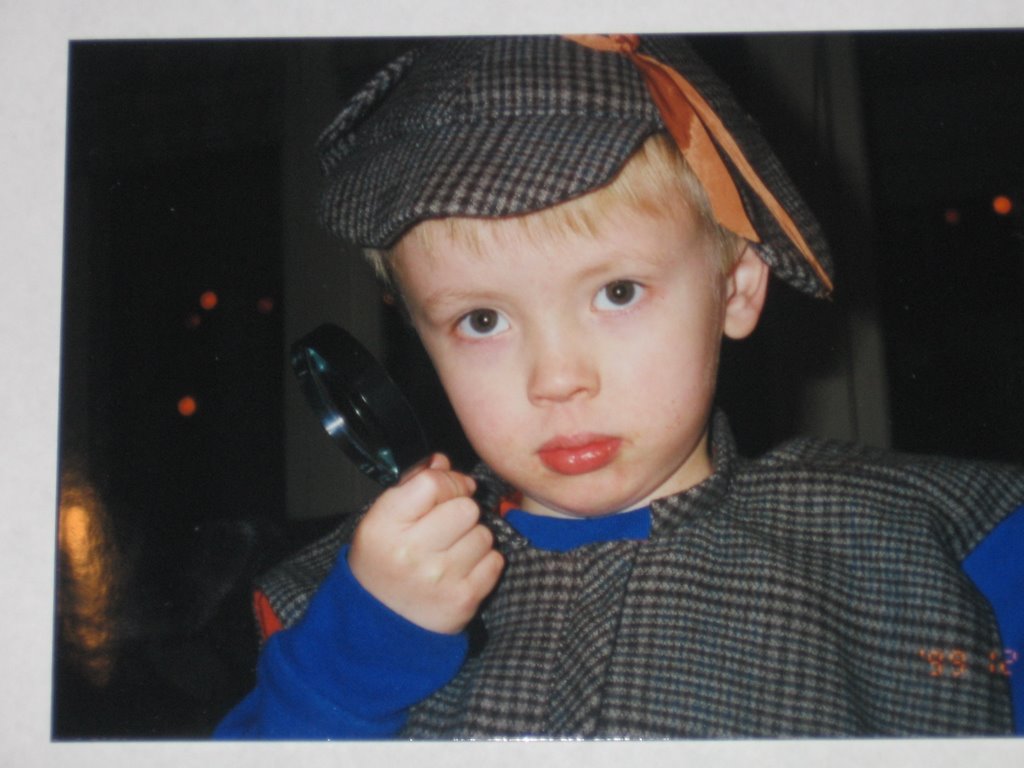
Photo: My oldest son as a chocolatey Sherlock Holmes, in a distant past.
These two things don’t always go together—at least not as smoothly as I’d wish. For one thing, boys will ask for all the attention you have, and then lots of attention beyond that. They want to wrestle dangerously near the coffee table, pick up the cat under his stomach right after he drinks milk, and see what happens when you blow in the dog’s face. (The answer to the last one is—he goes insane and bites your baby lip, whereupon you cry and leave gouts of blood all over the house like you’re auditioning for Macbeth). They want to tattle on each other and jump on the neighbor’s trampoline (blast the neighbor) and argue over one Lego even while they sit in a veritable sea of them, wave upon wave of unwanted Legos that are good only for adults to step on in the dark.
Naturally this does not allow one to sit at the computer for a long, leisurely time, at least not without yelling “Cut it OUT!” at regular intervals, and this rather breaks the concentration. So one must write when one can. And when one is me, that means I write in fits and starts. Not only am I sometimes called away by my boys; there is my mother guilt to contend with. It’s always been there, of course, ever since that first day when I allowed the doctor to circumcise my baby at the hospital and then felt miserable for weeks afterward at what I’d let those evil doctors do. By the time my first infant rolled off the bed while I was hunting for a pair of socks, my guilt was firmly and permanently in place. I called the hospital, weeping harder than the baby, and the doctor asked me in a bored tone if the baby was, perchance, vomiting. No, said I, and he said, “Babies have hard heads.”
Due to guilt, one cannot write all day long, especially not when cute children ask, “Can you read this to me?” You can’t ignore that, not unless you want Harry Chapin singing in the back of your mind all day about cats and cradles and silver spoons. Sometimes you can’t write at all. I’ve had a lovely leisurely summer, but soon I’ll go back to work and night school, which I call Panic Attack Season.
Ironically, though, when one is inundated with non-writer responsibilities, one can develop writer guilt. Similar to mother guilt, it niggles at the back of one’s mind (also, ironically, to the tune of a Harry Chapin song) and asks why there is no new project in the offing and why the old project hasn’t been polished smooth.
So when I lie next to the boys at night and sing them a few lullabies—yes, I do it, but not in as Julie Andrews a way as I’d like—I find that my writer guilt is there, saying ‘Get downstairs and type something.’ But there’s always a boy with insomnia, always, and he’s not that thrilled with the idea of my departure. So I become half sweet lullaby mother, half grumpy military mother who wants to leave. It sounds like this:
ME: (soft and lilting) Oh Danny Boy, the pipes, the pipes are calling—
BOY: How can pipes call?
ME: (not lilting) No talking. From glen to glen, and down the mountainside . . . PUT YOUR ARMS DOWN! The summer’s gone . . . and all the roses falling . . . ‘tis you, ‘tis you—GET YOUR FEET OFF THE WALL!
BOY: Who farted?
ME: (Not even distantly related to lilting) That’s IT. I’m getting your father.
And the challenge continues. Not surprisingly, there are children in every book I’ve written so far. I’ve been told I write children very realistically. I guess it’s from being in the mother trenches. Does this help at all with writing mysteries? Well, writers who are parents deal with a daily mystery—how are they ever going to get anything done!
(Disclosure: I actually wrote this essay two years ago this summer. My oldest boy is now officially a teen, and he doesn't require singing at night anymore, which is most bittersweet. They allow me a lot more time on the computer, although they distract me in other ways. The new way to take Mom's attention is to fight like ancient warriors on the living room floor until maternal intervention is required. Brothers love each other, except when they hate each other.
I still write books with children in them, though. Some things will never change.)
Photo: My oldest son as a chocolatey Sherlock Holmes, in a distant past.
Saturday, July 5, 2008
Annie's Amazing Grammar Quiz
by Darlene Ryan
My friend Annie is a spelling and grammar junkie. Ask her to explain the difference between lay and lie or who and whom and her eyes light up. Not only does Annie love word quizzes, she also likes to make them up and send them to me. This weekend she’s put together a grammar quiz especially for PDD readers. The answers follow the questions. You’re on your honor not to cheat. Please share your score in comments. (I got 7 out of 10.)
Annie’s Amazing Grammar Quiz
1. Which phrase is correct?
A. Peter and John’s boat.
B. Peter’s and John’s boat.
2. Which sentence is correct?
A. Between you and I, the book is boring.
B. Between you and me, the book is boring.
A. My neighbor, Lynn, has a gorgeous flower garden.
B. My neighbor Lynn has a gorgeous flower garden.
A. is
B. are
A. I gave cookies to the boys who had behaved.
B. I gave cookies to the boys, who had behaved.
6. Which sentence is correct?A. Who’s bringing the cake, and whose cottage is whose?
B. Whose bringing the cake, and whose cottage is who’s?
C. Who’s bringing the cake, and who’s cottage is whose?
D. Who’s bringing the cake, and who’s cottage is who’s?
7. Remember to pick up Bill and ____tomorrow.
A. me
B. I
8. If you only have one grandmother, which sentence is correct?A. My grandmother, Edith, went sky-diving on her birthday.
B. My grandmother Edith went sky-diving on her birthday.
B. whom
10. Which sentence is correct?A. The winning bid was your’s.
B. The winning bid was yours.
Answers: (No peeking before trying the questions.)
In this case the boat belongs to Peter and John so only the second name gets the possessive. If the sentence was referring to one boat belonging to Peter and one belonging to John it would read “Peter’s and John’s boats.”
Between is a preposition. You and me are objects of that preposition. I can’t be the object of a preposition. “Between you and I” is always wrong.
3. Answer: B
The second sentence, without any commas, tells the reader
4. Answer: A
The subject of the sentence is neither, which is singular, and thus requires a singular verb.
5. Answer: B
Using the comma makes the phrase after it a non-restrictive clause. The phrase could be taken out of the sentence and the meaning would still be clear.
6. Answer: A
Who’s, a contraction for who is, is the correct word at the beginning of the sentence. Whose is the possessive case of who, thus “whose cottage is whose” is correct.
7. Answer: A
The sentence needs an object pronoun. I is a subject pronoun. Me, an object pronoun, is correct. To make it easier rearrange the sentence removing Bill and chose between me and I:
Remember to pick up____tomorrow. The correct choice is me, the object pronoun.
8. Answer: A
Commas before and after the name tell the reader you only have one grandmother.
9. Answer B
Who is a subject pronoun like she, he and they. Whom is an object pronoun like her, him and them. To make it easier to decide whether you need a subject pronoun or an object pronoun, rearrange the phrase and chose between him and he:
My sister has always secretly loved______. The correct choice is him, the object pronoun, which means you need whom in the original sentence.
10. Answer B
Yours is the possessive pronoun.
I’ve been torturing…I mean testing my friends all week and no one has gotten all the questions right. So, how did you do?
Friday, July 4, 2008
Fourth of July
By Lonnie Cruse
Fourth of July. I think back to watching the fireworks at Cashman Field in Las Vegas, NV when I was a little girl. I hated the loud ones that go boom with no sparkles. All noise and no beauty. Still hate them. But I love the newer ones that spread out like a bow tie. Or those that go off, and off, and off, and . . . . Wow!
Fourth of July. Most times it's too hot and muggy, now and then it's rainy, and once in a blue moon, it's downright cold. Picnics, pot lucks, too much food, too many people, legal fireworks the city sets off over the river or illegal fireworks somebody's cousin slipped off to Sikeston, MO to buy and set off. Skeeter bugs, bug spray, candles, paper plates, and the neighbor's dog, hoping to score some dropped food. Sparklers swung in circles, lighting up the night. Red, white, and blue. Uncle Sam. Patriotism.
Fourth of July. However you celebrate the anniversary of our free country, and hopefully give thanks to those who died to keep it that way, may you have way too much fun and too much food and too many people in your life. And too many fireworks. Do, please, be careful. Those sparklers get hot.
Subscribe to:
Posts (Atom)