

 Posts
Posts


Sharon Wildwind
Once, in a short story, I read about a man who could not tell stories. Embarrassed at this lack of social skill, he practiced. Standing in front of a mirror, he rehearsed how to hold his head, his facial expressions, how to use his hands to illustrate the story’s climax, and when to raise or lower his voice. He became a hit at parties, but in the end he rehearsed one story too many. That was the story of witnessing his brother’s accidental death. When it came time to talk to the police, he had the details down too pat.
I’ve always like my stories more spontaneous. My friend Edward’s tale of hitchhiking from South America to the U.S./Mexican border, crossing through several countries, without a passport. What happened when my music teacher literally bumped into Queen Elizabeth while she was emptying used tea leaves into her flower bed at Balmoral Castle. How an acquaintance’s father was killed by cannibals in New Guinea.
We all know what makes a good story. Intrigue. Suspense. A breaking down of barriers. A touch of the exotic. Of course, timing is everything. Some stories should only be told in a cheap diner, over a plate of sizzling French fries, at two in the morning, after a night of partying. Others work better under a big pecan tree, in a circle of aunts, where clicking of knitting needles and ice tinkling in large tea glasses punctuate the details.
I suspect that writers—even young proto-writers—have natural antennae for stories. One of the first lessons we learn is not to interrupt. We might miss something if we did, or worse, the storyteller might be distracted and never come back to finish the tale.
Another thing we become good at is listening to the same story more than once, because we’ve figured out that the same story is never really the same. There’s always once nuisance, whether it be a small detail or the change in tone of voice, that suddenly reveals more about the story behind the story.
When I was about four years old, my father’s job kept him away from home for several days at a time. My mother didn’t like being at home alone with two small children, and she had a cousin, who also travelled in his work. She was quite glad for her cousin to stay in our spare bedroom when he came through town. One day, in the grocery store, my mother was talking about her cousin to a neighbor. I was having a hard time remembering who the cousin was and my mother reminded me he had an alarm clock that made a noise I found funny. “Oh,” I said loudly in the middle of the store, “You mean the man who comes to stay every time Daddy’s out of town.”
That was when I learned that some stories were sacred, or at least private.
-----
Writing quote for the week:
Long before I wrote stories, I listened for stories. Listening for them is something more acute than listening to them. When their elders sit and begin, children are just waiting and hoping for one to come out, like a mouse from its hole.
~Eudora Welty, southern writer
Tuesday, July 8, 2008


Monday, July 7, 2008
Raising Boys and Writing Mysteries
by Julia Buckley

These two things don’t always go together—at least not as smoothly as I’d wish. For one thing, boys will ask for all the attention you have, and then lots of attention beyond that. They want to wrestle dangerously near the coffee table, pick up the cat under his stomach right after he drinks milk, and see what happens when you blow in the dog’s face. (The answer to the last one is—he goes insane and bites your baby lip, whereupon you cry and leave gouts of blood all over the house like you’re auditioning for Macbeth). They want to tattle on each other and jump on the neighbor’s trampoline (blast the neighbor) and argue over one Lego even while they sit in a veritable sea of them, wave upon wave of unwanted Legos that are good only for adults to step on in the dark.
Naturally this does not allow one to sit at the computer for a long, leisurely time, at least not without yelling “Cut it OUT!” at regular intervals, and this rather breaks the concentration. So one must write when one can. And when one is me, that means I write in fits and starts. Not only am I sometimes called away by my boys; there is my mother guilt to contend with. It’s always been there, of course, ever since that first day when I allowed the doctor to circumcise my baby at the hospital and then felt miserable for weeks afterward at what I’d let those evil doctors do. By the time my first infant rolled off the bed while I was hunting for a pair of socks, my guilt was firmly and permanently in place. I called the hospital, weeping harder than the baby, and the doctor asked me in a bored tone if the baby was, perchance, vomiting. No, said I, and he said, “Babies have hard heads.”
Due to guilt, one cannot write all day long, especially not when cute children ask, “Can you read this to me?” You can’t ignore that, not unless you want Harry Chapin singing in the back of your mind all day about cats and cradles and silver spoons. Sometimes you can’t write at all. I’ve had a lovely leisurely summer, but soon I’ll go back to work and night school, which I call Panic Attack Season.
Ironically, though, when one is inundated with non-writer responsibilities, one can develop writer guilt. Similar to mother guilt, it niggles at the back of one’s mind (also, ironically, to the tune of a Harry Chapin song) and asks why there is no new project in the offing and why the old project hasn’t been polished smooth.
So when I lie next to the boys at night and sing them a few lullabies—yes, I do it, but not in as Julie Andrews a way as I’d like—I find that my writer guilt is there, saying ‘Get downstairs and type something.’ But there’s always a boy with insomnia, always, and he’s not that thrilled with the idea of my departure. So I become half sweet lullaby mother, half grumpy military mother who wants to leave. It sounds like this:
ME: (soft and lilting) Oh Danny Boy, the pipes, the pipes are calling—
BOY: How can pipes call?
ME: (not lilting) No talking. From glen to glen, and down the mountainside . . . PUT YOUR ARMS DOWN! The summer’s gone . . . and all the roses falling . . . ‘tis you, ‘tis you—GET YOUR FEET OFF THE WALL!
BOY: Who farted?
ME: (Not even distantly related to lilting) That’s IT. I’m getting your father.
And the challenge continues. Not surprisingly, there are children in every book I’ve written so far. I’ve been told I write children very realistically. I guess it’s from being in the mother trenches. Does this help at all with writing mysteries? Well, writers who are parents deal with a daily mystery—how are they ever going to get anything done!
(Disclosure: I actually wrote this essay two years ago this summer. My oldest boy is now officially a teen, and he doesn't require singing at night anymore, which is most bittersweet. They allow me a lot more time on the computer, although they distract me in other ways. The new way to take Mom's attention is to fight like ancient warriors on the living room floor until maternal intervention is required. Brothers love each other, except when they hate each other.
I still write books with children in them, though. Some things will never change.)
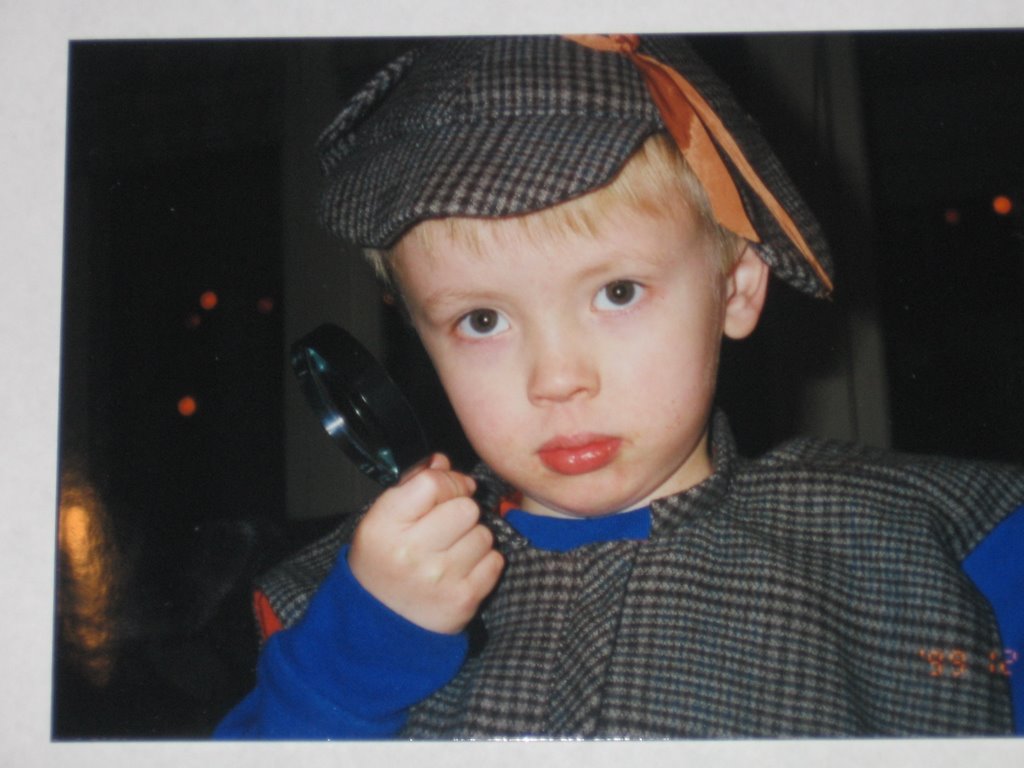
Photo: My oldest son as a chocolatey Sherlock Holmes, in a distant past.
These two things don’t always go together—at least not as smoothly as I’d wish. For one thing, boys will ask for all the attention you have, and then lots of attention beyond that. They want to wrestle dangerously near the coffee table, pick up the cat under his stomach right after he drinks milk, and see what happens when you blow in the dog’s face. (The answer to the last one is—he goes insane and bites your baby lip, whereupon you cry and leave gouts of blood all over the house like you’re auditioning for Macbeth). They want to tattle on each other and jump on the neighbor’s trampoline (blast the neighbor) and argue over one Lego even while they sit in a veritable sea of them, wave upon wave of unwanted Legos that are good only for adults to step on in the dark.
Naturally this does not allow one to sit at the computer for a long, leisurely time, at least not without yelling “Cut it OUT!” at regular intervals, and this rather breaks the concentration. So one must write when one can. And when one is me, that means I write in fits and starts. Not only am I sometimes called away by my boys; there is my mother guilt to contend with. It’s always been there, of course, ever since that first day when I allowed the doctor to circumcise my baby at the hospital and then felt miserable for weeks afterward at what I’d let those evil doctors do. By the time my first infant rolled off the bed while I was hunting for a pair of socks, my guilt was firmly and permanently in place. I called the hospital, weeping harder than the baby, and the doctor asked me in a bored tone if the baby was, perchance, vomiting. No, said I, and he said, “Babies have hard heads.”
Due to guilt, one cannot write all day long, especially not when cute children ask, “Can you read this to me?” You can’t ignore that, not unless you want Harry Chapin singing in the back of your mind all day about cats and cradles and silver spoons. Sometimes you can’t write at all. I’ve had a lovely leisurely summer, but soon I’ll go back to work and night school, which I call Panic Attack Season.
Ironically, though, when one is inundated with non-writer responsibilities, one can develop writer guilt. Similar to mother guilt, it niggles at the back of one’s mind (also, ironically, to the tune of a Harry Chapin song) and asks why there is no new project in the offing and why the old project hasn’t been polished smooth.
So when I lie next to the boys at night and sing them a few lullabies—yes, I do it, but not in as Julie Andrews a way as I’d like—I find that my writer guilt is there, saying ‘Get downstairs and type something.’ But there’s always a boy with insomnia, always, and he’s not that thrilled with the idea of my departure. So I become half sweet lullaby mother, half grumpy military mother who wants to leave. It sounds like this:
ME: (soft and lilting) Oh Danny Boy, the pipes, the pipes are calling—
BOY: How can pipes call?
ME: (not lilting) No talking. From glen to glen, and down the mountainside . . . PUT YOUR ARMS DOWN! The summer’s gone . . . and all the roses falling . . . ‘tis you, ‘tis you—GET YOUR FEET OFF THE WALL!
BOY: Who farted?
ME: (Not even distantly related to lilting) That’s IT. I’m getting your father.
And the challenge continues. Not surprisingly, there are children in every book I’ve written so far. I’ve been told I write children very realistically. I guess it’s from being in the mother trenches. Does this help at all with writing mysteries? Well, writers who are parents deal with a daily mystery—how are they ever going to get anything done!
(Disclosure: I actually wrote this essay two years ago this summer. My oldest boy is now officially a teen, and he doesn't require singing at night anymore, which is most bittersweet. They allow me a lot more time on the computer, although they distract me in other ways. The new way to take Mom's attention is to fight like ancient warriors on the living room floor until maternal intervention is required. Brothers love each other, except when they hate each other.
I still write books with children in them, though. Some things will never change.)
Photo: My oldest son as a chocolatey Sherlock Holmes, in a distant past.
Saturday, July 5, 2008
Annie's Amazing Grammar Quiz
by Darlene Ryan
My friend Annie is a spelling and grammar junkie. Ask her to explain the difference between lay and lie or who and whom and her eyes light up. Not only does Annie love word quizzes, she also likes to make them up and send them to me. This weekend she’s put together a grammar quiz especially for PDD readers. The answers follow the questions. You’re on your honor not to cheat. Please share your score in comments. (I got 7 out of 10.)
Annie’s Amazing Grammar Quiz
1. Which phrase is correct?
A. Peter and John’s boat.
B. Peter’s and John’s boat.
2. Which sentence is correct?
A. Between you and I, the book is boring.
B. Between you and me, the book is boring.
A. My neighbor, Lynn, has a gorgeous flower garden.
B. My neighbor Lynn has a gorgeous flower garden.
A. is
B. are
A. I gave cookies to the boys who had behaved.
B. I gave cookies to the boys, who had behaved.
6. Which sentence is correct?A. Who’s bringing the cake, and whose cottage is whose?
B. Whose bringing the cake, and whose cottage is who’s?
C. Who’s bringing the cake, and who’s cottage is whose?
D. Who’s bringing the cake, and who’s cottage is who’s?
7. Remember to pick up Bill and ____tomorrow.
A. me
B. I
8. If you only have one grandmother, which sentence is correct?A. My grandmother, Edith, went sky-diving on her birthday.
B. My grandmother Edith went sky-diving on her birthday.
B. whom
10. Which sentence is correct?A. The winning bid was your’s.
B. The winning bid was yours.
Answers: (No peeking before trying the questions.)
In this case the boat belongs to Peter and John so only the second name gets the possessive. If the sentence was referring to one boat belonging to Peter and one belonging to John it would read “Peter’s and John’s boats.”
Between is a preposition. You and me are objects of that preposition. I can’t be the object of a preposition. “Between you and I” is always wrong.
3. Answer: B
The second sentence, without any commas, tells the reader
4. Answer: A
The subject of the sentence is neither, which is singular, and thus requires a singular verb.
5. Answer: B
Using the comma makes the phrase after it a non-restrictive clause. The phrase could be taken out of the sentence and the meaning would still be clear.
6. Answer: A
Who’s, a contraction for who is, is the correct word at the beginning of the sentence. Whose is the possessive case of who, thus “whose cottage is whose” is correct.
7. Answer: A
The sentence needs an object pronoun. I is a subject pronoun. Me, an object pronoun, is correct. To make it easier rearrange the sentence removing Bill and chose between me and I:
Remember to pick up____tomorrow. The correct choice is me, the object pronoun.
8. Answer: A
Commas before and after the name tell the reader you only have one grandmother.
9. Answer B
Who is a subject pronoun like she, he and they. Whom is an object pronoun like her, him and them. To make it easier to decide whether you need a subject pronoun or an object pronoun, rearrange the phrase and chose between him and he:
My sister has always secretly loved______. The correct choice is him, the object pronoun, which means you need whom in the original sentence.
10. Answer B
Yours is the possessive pronoun.
I’ve been torturing…I mean testing my friends all week and no one has gotten all the questions right. So, how did you do?
Friday, July 4, 2008
Fourth of July
By Lonnie Cruse
Fourth of July. I think back to watching the fireworks at Cashman Field in Las Vegas, NV when I was a little girl. I hated the loud ones that go boom with no sparkles. All noise and no beauty. Still hate them. But I love the newer ones that spread out like a bow tie. Or those that go off, and off, and off, and . . . . Wow!
Fourth of July. Most times it's too hot and muggy, now and then it's rainy, and once in a blue moon, it's downright cold. Picnics, pot lucks, too much food, too many people, legal fireworks the city sets off over the river or illegal fireworks somebody's cousin slipped off to Sikeston, MO to buy and set off. Skeeter bugs, bug spray, candles, paper plates, and the neighbor's dog, hoping to score some dropped food. Sparklers swung in circles, lighting up the night. Red, white, and blue. Uncle Sam. Patriotism.
Fourth of July. However you celebrate the anniversary of our free country, and hopefully give thanks to those who died to keep it that way, may you have way too much fun and too much food and too many people in your life. And too many fireworks. Do, please, be careful. Those sparklers get hot.
Fourth of July. I think back to watching the fireworks at Cashman Field in Las Vegas, NV when I was a little girl. I hated the loud ones that go boom with no sparkles. All noise and no beauty. Still hate them. But I love the newer ones that spread out like a bow tie. Or those that go off, and off, and off, and . . . . Wow!
Fourth of July. Most times it's too hot and muggy, now and then it's rainy, and once in a blue moon, it's downright cold. Picnics, pot lucks, too much food, too many people, legal fireworks the city sets off over the river or illegal fireworks somebody's cousin slipped off to Sikeston, MO to buy and set off. Skeeter bugs, bug spray, candles, paper plates, and the neighbor's dog, hoping to score some dropped food. Sparklers swung in circles, lighting up the night. Red, white, and blue. Uncle Sam. Patriotism.
Fourth of July. However you celebrate the anniversary of our free country, and hopefully give thanks to those who died to keep it that way, may you have way too much fun and too much food and too many people in your life. And too many fireworks. Do, please, be careful. Those sparklers get hot.
Thursday, July 3, 2008
Wrapping Up the Book Tour
Elizabeth Zelvin
I'm home from the road after more than two months of touring to promote Death Will Get You Sober. I've had a grand time, and I'm glad to be home and ready for a rest--except for updating all the information on the website, unpacking the mountain of stuff I somehow managed to fit into two suitcases at under 50 pounds for the airlines' rigorous new limits, laundering, filing, and throwing away all that stuff as appropriate, opening mail, paying bills, printing out all the text that's been accumulating on my laptop, reconnecting with family and friends, and thinking about what I'll write next.
I came back with more books than I started with, more friends than I started with, and enormous respect for the booksellers and librarians who keep the love of books alive and booklovers' insatiable desire for more satisfied one book at a time.
I'm also grateful for 21st century technology: my laptop, which kept me available to my therapy clients in the US and the UK; Sadie the GPS, who found every destination I needed to go, kept me company on long drives, and never once lost her temper; my digital camera, which recorded priceless moments like my signing at Book Passage with Salman Rushdie (we signed in different rooms, but it was a great photo op); my cell modem, which linked me to the Internet when my aging computer didn't want to talk to the wireless connections in friends' homes and cafés; my Bluetooth earpiece, which let me keep both hands on the wheel; and my cell phone, which kept me connected with the old and new friends who put me up in their homes, fed me, drove me across state lines, up and down mountains, and all around urban mazes to give me and Sadie a break, and supported the book and my events in all sorts of ways. Phone and email also allowed me to keep track of a million and one details and stay in touch with my husband and the folks at my publisher's in New York, my publicist, PJ Nunn, in Texas, and booksellers and librarians in Arizona, California, Connecticut, Florida, Indiana, North Carolina, New Jersey, New York, Ohio, Pennsylvania, Virginia, Washington, and Wisconsin.
The tour started at the Public Library Association convention in Minneapolis at the end of March (15 or 20 Sisters in Crime and 10,000 librarians) and ended at the American Library Association's annual meeting in Anaheim (15 or 20 Sisters in Crime and 25,000 librarians). Heartfelt thanks to the mystery writers all over the country who proved over and over the truth of the saying that writers in our genre are unfailingly generous and helpful to each other--and to the readers who enjoyed Death Will Get You Sober, told me they loved the title and the cover, asked me when the next one will come out, and talked about Bruce and Barbara and Jimmy as if they were not just fictional characters but real people.
I'm home from the road after more than two months of touring to promote Death Will Get You Sober. I've had a grand time, and I'm glad to be home and ready for a rest--except for updating all the information on the website, unpacking the mountain of stuff I somehow managed to fit into two suitcases at under 50 pounds for the airlines' rigorous new limits, laundering, filing, and throwing away all that stuff as appropriate, opening mail, paying bills, printing out all the text that's been accumulating on my laptop, reconnecting with family and friends, and thinking about what I'll write next.
I came back with more books than I started with, more friends than I started with, and enormous respect for the booksellers and librarians who keep the love of books alive and booklovers' insatiable desire for more satisfied one book at a time.
I'm also grateful for 21st century technology: my laptop, which kept me available to my therapy clients in the US and the UK; Sadie the GPS, who found every destination I needed to go, kept me company on long drives, and never once lost her temper; my digital camera, which recorded priceless moments like my signing at Book Passage with Salman Rushdie (we signed in different rooms, but it was a great photo op); my cell modem, which linked me to the Internet when my aging computer didn't want to talk to the wireless connections in friends' homes and cafés; my Bluetooth earpiece, which let me keep both hands on the wheel; and my cell phone, which kept me connected with the old and new friends who put me up in their homes, fed me, drove me across state lines, up and down mountains, and all around urban mazes to give me and Sadie a break, and supported the book and my events in all sorts of ways. Phone and email also allowed me to keep track of a million and one details and stay in touch with my husband and the folks at my publisher's in New York, my publicist, PJ Nunn, in Texas, and booksellers and librarians in Arizona, California, Connecticut, Florida, Indiana, North Carolina, New Jersey, New York, Ohio, Pennsylvania, Virginia, Washington, and Wisconsin.
The tour started at the Public Library Association convention in Minneapolis at the end of March (15 or 20 Sisters in Crime and 10,000 librarians) and ended at the American Library Association's annual meeting in Anaheim (15 or 20 Sisters in Crime and 25,000 librarians). Heartfelt thanks to the mystery writers all over the country who proved over and over the truth of the saying that writers in our genre are unfailingly generous and helpful to each other--and to the readers who enjoyed Death Will Get You Sober, told me they loved the title and the cover, asked me when the next one will come out, and talked about Bruce and Barbara and Jimmy as if they were not just fictional characters but real people.
Wednesday, July 2, 2008
Would you protect a criminal?
Sandra Parshall
It’s a common theme in novels and on TV: the parent, spouse, child, friend or lover who will go to any lengths to protect a loved one who has committed a crime. The various Law & Order shows use this kind of “twist” so often I can see it coming early in the story and always groan, Not again.
Fictional parents, in particular, seem willing to do anything to prevent their kids from facing the consequences of their actions. A teenager killed somebody? The parents may try to cast blame on someone else – someone innocent – and if that doesn’t work, either Mom or Dad will confess to the crime. Sometimes it turns out the kid really didn’t do it, so the whole family is off the hook after the parents have proved how much they love their offspring. I always get the strong feeling the audience or reader is supposed to find this heartwarming.
How true to life is such a scenario? I’ve heard of plenty of people who decided not to report crimes, but most seem to have been motivated by a desire not to get dragged into a legal mess. Some of these stories are bizarre. A few years ago a young man here in Northern Virginia murdered his family and left their bodies in their Great Falls mansion for about a year. He told local acquaintances they had all gone home to Hong Kong and been killed in an auto accident. He told Hong Kong relatives and friends they died in an accident in the US. During the time their bodies were decomposing in the family mansion, the killer took his fiancé there, showed her his handiwork, and told her what he had done. How did she react? She broke off her relationship with him –- and kept silent about the murders. It happens. The desire not to “get involved” seems deeply ingrained in human nature.
But how many people would actively protect a loved one who has committed murder? We’ve all heard stories about relatives turning people in. The Unabomber’s brother identified him and helped authorities catch him. A young boy who murdered a neighborhood girl and hid her body in his room was reported to the police by his mother. How many people, hearing of these incidents, shook their heads and said they could never rat out a family member?
What emotions are fiction writers trying to touch in their audience when they portray a family’s frantic effort to cover up a crime? Is this supposed to be a noble, selfless course of action that will give the offender a chance to go on to a normal, happy life? Does anyone believe that’s possible? Does anyone think ahead and wonder about the future of a young killer who has learned he can get away with murder? Would you want a kid who had murdered somebody sleeping down the hall from you every night? Or would he still be your sweet baby boy, no matter what he’s done? Would you go to extraordinary lengths to keep him out of prison?
Suppose the crime were less serious – shoplifting, for example, something a lot of kids do at one time or another. Merchants these days, suffering huge losses to theft, tend to come down hard on shoplifters of any age. Are parents justified in trying to keep their kids out of the juvenile justice system for stealing a small item from a store?
Physical bullying used to be seen as a rite of passage, something a lot of kids have to put up with. Fathers would teach their sons how to fight back. But now bullying is more likely to result in assault charges and lawsuits. Bullies who were once given time to grow out of their aggression now find themselves facing a judge. And in many cases, their parents vigorously defend them, determined their kids will not be punished for “kid stuff” that ought to be shrugged off. Should these parents try to protect their children, or should they let the kids face the consequences of their actions?
What would you do if you knew a loved one had committed a crime? Have you ever read a novel or watched a TV show or movie that made you stop and wonder how you would react if you faced the same dilemma as the fictional characters?
It’s a common theme in novels and on TV: the parent, spouse, child, friend or lover who will go to any lengths to protect a loved one who has committed a crime. The various Law & Order shows use this kind of “twist” so often I can see it coming early in the story and always groan, Not again.
Fictional parents, in particular, seem willing to do anything to prevent their kids from facing the consequences of their actions. A teenager killed somebody? The parents may try to cast blame on someone else – someone innocent – and if that doesn’t work, either Mom or Dad will confess to the crime. Sometimes it turns out the kid really didn’t do it, so the whole family is off the hook after the parents have proved how much they love their offspring. I always get the strong feeling the audience or reader is supposed to find this heartwarming.
How true to life is such a scenario? I’ve heard of plenty of people who decided not to report crimes, but most seem to have been motivated by a desire not to get dragged into a legal mess. Some of these stories are bizarre. A few years ago a young man here in Northern Virginia murdered his family and left their bodies in their Great Falls mansion for about a year. He told local acquaintances they had all gone home to Hong Kong and been killed in an auto accident. He told Hong Kong relatives and friends they died in an accident in the US. During the time their bodies were decomposing in the family mansion, the killer took his fiancé there, showed her his handiwork, and told her what he had done. How did she react? She broke off her relationship with him –- and kept silent about the murders. It happens. The desire not to “get involved” seems deeply ingrained in human nature.
But how many people would actively protect a loved one who has committed murder? We’ve all heard stories about relatives turning people in. The Unabomber’s brother identified him and helped authorities catch him. A young boy who murdered a neighborhood girl and hid her body in his room was reported to the police by his mother. How many people, hearing of these incidents, shook their heads and said they could never rat out a family member?
What emotions are fiction writers trying to touch in their audience when they portray a family’s frantic effort to cover up a crime? Is this supposed to be a noble, selfless course of action that will give the offender a chance to go on to a normal, happy life? Does anyone believe that’s possible? Does anyone think ahead and wonder about the future of a young killer who has learned he can get away with murder? Would you want a kid who had murdered somebody sleeping down the hall from you every night? Or would he still be your sweet baby boy, no matter what he’s done? Would you go to extraordinary lengths to keep him out of prison?
Suppose the crime were less serious – shoplifting, for example, something a lot of kids do at one time or another. Merchants these days, suffering huge losses to theft, tend to come down hard on shoplifters of any age. Are parents justified in trying to keep their kids out of the juvenile justice system for stealing a small item from a store?
Physical bullying used to be seen as a rite of passage, something a lot of kids have to put up with. Fathers would teach their sons how to fight back. But now bullying is more likely to result in assault charges and lawsuits. Bullies who were once given time to grow out of their aggression now find themselves facing a judge. And in many cases, their parents vigorously defend them, determined their kids will not be punished for “kid stuff” that ought to be shrugged off. Should these parents try to protect their children, or should they let the kids face the consequences of their actions?
What would you do if you knew a loved one had committed a crime? Have you ever read a novel or watched a TV show or movie that made you stop and wonder how you would react if you faced the same dilemma as the fictional characters?
Tuesday, July 1, 2008
Summer Crime
Sharon Wildwind
Happy Canada Day and, for those south of the border, Happy 4th of July in a few days.
To celebrate Canada Day, here’s a list of the 2008 winners of the Arthur Ellis Award, announced last month by Crime Writers of Canada. The best of the best in Canadian crime fiction, these books and stories would make a nice addition to your summer reading list.
Best novel
Jon Redfern, Trumpets Sound No More, RendezVous Crime
Best first novel
Liam Durcan, Garcia’s Heart, McClelland & Stewart
Best juvenile
Shane Peacock, Eye of the Crow, Tundra
Best crime novel in French
Mario Bolduc, Tsiganes, Libre Expression
Best short story
Leslie Watts, “Turners,” printed in the Kingston (Ontario) Whig-Standard, July 7, 2007 as part of their summer mystery series from Ontario authors
Best crime non-fiction
Julian Sher, One Child at a Time: The Global Fight to Rescue Children from Online Predators, Vintage Canada/Random House of Canada
This last one you won’t be able to read—yet, but hopefully winning the Best Unpublished First Novel award will soon land Dorothy McIntosh a contract for The Witch of Babylon
I’m devoting my summer to watching as well as reading. I’ve just finished season four of A Touch of Frost. This wonderful British police procedural, first aired in 1992, still makes an occasional appearance with a new made-for-TV movie. All of the seasons are available on DVD from Granada International.
Jack Frost—okay, the name on his medal for bravery is William Edward Frost, but everyone calls him Jack—is an aging, rumpled cop in the mythical English town of Denton (For Denton, imagine Reading, a town of between 100,000 and 200,000 people, 41 miles due west of London.)
Jack never does paperwork, has trouble remembering the revised caution format, and burns his own house down by leaving a chip pan (deep fat fryer) on the stove when he hurries out to answer a call. But he also knows life on the street, sometimes from a too-personal perspective. He is the bane of his Superintendent’s existence and that of a slew of younger detectives assigned to him to either teach him a lesson or for him to teach them one.
One of the nice things about being able to watch multiple episodes in a short time is that patterns emerge. I’ve been particularly struck by just how tightly this series makes use of the traditional red herring. There is always a limited pool of suspects, but the story line keeps you guessing.
He did it. No, she did it. No, he had to have done it. Okay, it must be her, but Frost has got it all wrong about why she did it. No, it’s definitely him after all. Oh, shoot, it’s the secretary after all. She’s been there in the background and I missed her all along!
For a comedy accent, you can’t beat Police Constable Ernie Trigg. PC Trigg works—I suspect lives—in a file room, where he has the name of every “person of interest” ever picked up by the Denton Constabulary hand-written and cross-filed on 5 x 8 index cards. Trigg is played by Arthur White, the older brother of David Jason, who so ably stars as Jack Frost.
So I’m going to spend my Canada Day afternoon with a lovely cold buffet, some iced tea, and mayhem and crime on the streets of Denton. I wish you an equally enjoyable day.
And, if you have a few spare minutes, you might try http://www.internetvoicesradio.com/Arch-JanetESmith.htm, the June 30th program, where I was interviewed.
------
Writing quote for the week
The police procedural is not about what the cop does on the job, but what the job does to the cop.
~Joseph Wambaugh, police writer
Happy Canada Day and, for those south of the border, Happy 4th of July in a few days.
To celebrate Canada Day, here’s a list of the 2008 winners of the Arthur Ellis Award, announced last month by Crime Writers of Canada. The best of the best in Canadian crime fiction, these books and stories would make a nice addition to your summer reading list.
Best novel
Jon Redfern, Trumpets Sound No More, RendezVous Crime
Best first novel
Liam Durcan, Garcia’s Heart, McClelland & Stewart
Best juvenile
Shane Peacock, Eye of the Crow, Tundra
Best crime novel in French
Mario Bolduc, Tsiganes, Libre Expression
Best short story
Leslie Watts, “Turners,” printed in the Kingston (Ontario) Whig-Standard, July 7, 2007 as part of their summer mystery series from Ontario authors
Best crime non-fiction
Julian Sher, One Child at a Time: The Global Fight to Rescue Children from Online Predators, Vintage Canada/Random House of Canada
This last one you won’t be able to read—yet, but hopefully winning the Best Unpublished First Novel award will soon land Dorothy McIntosh a contract for The Witch of Babylon
I’m devoting my summer to watching as well as reading. I’ve just finished season four of A Touch of Frost. This wonderful British police procedural, first aired in 1992, still makes an occasional appearance with a new made-for-TV movie. All of the seasons are available on DVD from Granada International.
Jack Frost—okay, the name on his medal for bravery is William Edward Frost, but everyone calls him Jack—is an aging, rumpled cop in the mythical English town of Denton (For Denton, imagine Reading, a town of between 100,000 and 200,000 people, 41 miles due west of London.)
Jack never does paperwork, has trouble remembering the revised caution format, and burns his own house down by leaving a chip pan (deep fat fryer) on the stove when he hurries out to answer a call. But he also knows life on the street, sometimes from a too-personal perspective. He is the bane of his Superintendent’s existence and that of a slew of younger detectives assigned to him to either teach him a lesson or for him to teach them one.
One of the nice things about being able to watch multiple episodes in a short time is that patterns emerge. I’ve been particularly struck by just how tightly this series makes use of the traditional red herring. There is always a limited pool of suspects, but the story line keeps you guessing.
He did it. No, she did it. No, he had to have done it. Okay, it must be her, but Frost has got it all wrong about why she did it. No, it’s definitely him after all. Oh, shoot, it’s the secretary after all. She’s been there in the background and I missed her all along!
For a comedy accent, you can’t beat Police Constable Ernie Trigg. PC Trigg works—I suspect lives—in a file room, where he has the name of every “person of interest” ever picked up by the Denton Constabulary hand-written and cross-filed on 5 x 8 index cards. Trigg is played by Arthur White, the older brother of David Jason, who so ably stars as Jack Frost.
So I’m going to spend my Canada Day afternoon with a lovely cold buffet, some iced tea, and mayhem and crime on the streets of Denton. I wish you an equally enjoyable day.
And, if you have a few spare minutes, you might try http://www.internetvoicesradio.com/Arch-JanetESmith.htm, the June 30th program, where I was interviewed.
------
Writing quote for the week
The police procedural is not about what the cop does on the job, but what the job does to the cop.
~Joseph Wambaugh, police writer
Monday, June 30, 2008
The Fun of Lists, The Joy of Books

by Julia Buckley
This week Entertainment Weekly Magazine released several lists of what they called "The New Classics" in books, movies, music, etc. They were drawing their material from works produced in the last twenty-five years. I've already heard some complaints about what was left off of the list (which can be read here)
both because of things that were put on or things that were left off. Still, I like reading lists, because they give me a gauge for my own reading. I check how many of the books I've read, and I get a sense of how many of them I'd like to read.
To compare, here's a similar list of great books since 1923 that TIME Magazine compiled in 2005.
There are some books that the two lists have in common. In any case, I didn't fare so well on either list. On the first list, I've read 17 of the 100 books. On the second, I've read 12. Naturally, this makes me wonder which of those other 171 books I should read if I don't want to miss something really amazing. I will say that all of the books I read from the lists WERE most excellent books, so I'm assuming that some care was taken in the choosing of these novels.
The enjoyment of books is a subjective thing, though, and no one will ever agree entirely with anyone else's list.
But here's my question: where are all the mysteries? This seems to be such an ignored genre when people are composing their "great" lists--although I was pleased when Mayor Daley chose THE LONG GOODBYE for this year's One Book, One Chicago program.
But in general, mysteries seem to be overlooked as great fiction. In the EW list there are only two that are sort of mysteries--THE LOVELY BONES, which is about a murder, and narrated by the victim from heaven, and THE MYSTERIOUS CASE OF THE DOG IN THE NIGHTTIME, which is about an autistic boy who tries to solve the murder of a dog. Did I miss any? Did you see any other mysteries on those lists? And how many of the books have you read?
I realize I'm probably being most prosaic in counting my accomplishments (especially when they're not that impressive) but I find it fun, anyway. Share yours with us, as well!
Saturday, June 28, 2008
Sex Sells...or Does It?
L. J. Sellers
Sex sells. That’s what marketers always say. And it seems to be true for tight-fitting jeans and toothpaste. But it is true in crime fiction? In my experience—not necessarily.
Some of the best reviews I received for my novel, The Sex Club, started out with a disclaimer like this: “I didn’t think I would like this book, but . . .” The readers/reviewers went on to say that the title (and sometimes the cover) had turned them away from the book and that they’d read it reluctantly because another reader raved about it. They ended up loving the story, but still, their initial aversion concerned me.
After seeing the pattern, I asked members of Dorothly L (a reader/writer discussion forum) what they thought about the title. Many said they would never pick up the novel in a bookstore or library because of the title. So then I wondered: How many bookstores and libraries had decided not to stock the novel because of the title? From the comments of a few, I believe there might be many. After realizing this painful reality, I started adding this footnote to all my communications about the novel: “Despite the title, the story isn’t X-rated.” It is not a good sign when you have to explain or make excuses for your title.
On the other hand, many writers on the CrimeSpace and Facebook networking sites have posted great comments about The Sex Club’s cover and title. One writer posted, “Judging by the title, that’s a book I have to read right now.” Many others have simply said, “Love the cover!” and “I love the title!” Some even commented that they liked the book’s short pitch on Amazon: A dead girl, a ticking bomb, a Bible study that’s not what it appears to be, and a detective who won’t give up.
But when I started a discussion specifically asking how they felt about the word sex in a crime fiction title, the reaction was mixed. One writer said, “If sex is in the title, isn’t that a lot of emphasis, leading the buyer to think the book might be in the wrong section of the bookstore?” Another commented, “For me, the word sex would have to be relevant to the plot. I hate titles that just try to get people to buy even when it has nothing whatsoever to do with the story.”
The most interesting response was, “I just read an interview with the author of The Jane Austen Book Club and she said that everyone thought the words Jane Austen on the cover would be what sold the book, but in fact it was the words Book Club. It’s the same thing here, it’s the word club together with sex that’s interesting.”
In a similar online discussion, many people (mostly women) said they simply skip sex scenes when they come across them in mystery/suspense stories. I also feel that they drag down a fast-paced story, which is why I didn’t write any such scenes in the novel.
My publicist, who came on board after the book had been printed, felt very strongly that the title was a mistake and made both of our jobs a lot harder than they need to be. She thought that not only was I turning off mystery readers but also alienating other readers who were attracted to the title, then disappointed to find out the book didn’t have much sex in it.
I’ve come to believe she’s right. A quick search of Amazon brought up only one other mystery title with the word sex—Sex and Murder (A Paul Turner Mystery). But at least that author was smart enough to get the word murder in the title too. (Mystery readers love a good murder!) I’m sure there may be others, but after months of perusing thousands of reader postings on multiple list servs, I’ve yet to see another mystery title mention sex.
I debated the name, The Sex Club, for months, and finally went with it because it seemed perfect for the story. And, to be honest, I thought it might get media attention. But in retrospect, if I had it to do all over again, I’d change it. My conclusions: 1) Bookstores and libraries are critical to sales, and authors can’t afford to alienate them or their patrons, 2) Mystery readers prefer dead bodies to warm ones.
L.J. Sellers is an award-winning journalist, editor, and occasional standup comic, based in Eugene, Oregon. She is currently writing a second Detective Jackson story, Secrets to Die For.
Sex sells. That’s what marketers always say. And it seems to be true for tight-fitting jeans and toothpaste. But it is true in crime fiction? In my experience—not necessarily.
Some of the best reviews I received for my novel, The Sex Club, started out with a disclaimer like this: “I didn’t think I would like this book, but . . .” The readers/reviewers went on to say that the title (and sometimes the cover) had turned them away from the book and that they’d read it reluctantly because another reader raved about it.
 They ended up loving the story, but still, their initial aversion concerned me.
 After seeing the pattern, I asked members of Dorothly L (a reader/writer discussion forum) what they thought about the title. Many said they would never pick up the novel in a bookstore or library because of the title. So then I wondered: How many bookstores and libraries had decided not to stock the novel because of the title? From the comments of a few, I believe there might be many. After realizing this painful reality, I started adding this footnote to all my communications about the novel: “Despite the title, the story isn’t X-rated.” It is not a good sign when you have to explain or make excuses for your title.
On the other hand, many writers on the CrimeSpace and Facebook networking sites have posted great comments about The Sex Club’s cover and title. One writer posted, “Judging by the title, that’s a book I have to read right now.” Many others have simply said, “Love the cover!” and “I love the title!” Some even commented that they liked the book’s short pitch on Amazon: A dead girl, a ticking bomb, a Bible study that’s not what it appears to be, and a detective who won’t give up.
But when I started a discussion specifically asking how they felt about the word sex in a crime fiction title, the reaction was mixed.
 One writer said, “If sex is in the title, isn’t that a lot of emphasis, leading the buyer to think the book might be in the wrong section of the bookstore?” Another commented, “For me, the word sex would have to be relevant to the plot. I hate titles that just try to get people to buy even when it has nothing whatsoever to do with the story.”
The most interesting response was, “I just read an interview with the author of The Jane Austen Book Club and she said that everyone thought the words Jane Austen on the cover would be what sold the book, but in fact it was the words Book Club. It’s the same thing here, it’s the word club together with sex that’s interesting.”
In a similar online discussion, many people (mostly women) said they simply skip sex scenes when they come across them in mystery/suspense stories. I also feel that they drag down a fast-paced story, which is why I didn’t write any such scenes in the novel.
My publicist, who came on board after the book had been printed, felt very strongly that the title was a mistake and made both of our jobs a lot harder than they need to be. She thought that not only was I turning off mystery readers but also alienating other readers who were attracted to the title, then disappointed to find out the book didn’t have much sex in it.
I’ve come to believe she’s right. A quick search of Amazon brought up only one other mystery title with the word sex—Sex and Murder (A Paul Turner Mystery). But at least that author was smart enough to get the word murder in the title too. (Mystery readers love a good murder!) I’m sure there may be others, but after months of perusing thousands of reader postings on multiple list servs, I’ve yet to see another mystery title mention sex.
I debated the name, The Sex Club, for months, and finally went with it because it seemed perfect for the story. And, to be honest, I thought it might get media attention. But in retrospect, if I had it to do all over again, I’d change it. My conclusions: 1) Bookstores and libraries are critical to sales, and authors can’t afford to alienate them or their patrons, 2) Mystery readers prefer dead bodies to warm ones.
L.J. Sellers is an award-winning journalist, editor, and occasional standup comic, based in Eugene, Oregon. She is currently writing a second Detective Jackson story, Secrets to Die For.
Friday, June 27, 2008
What Aunt Ruby said happened that day was like this . . .
By Lonnie Cruse
Back in the day, my husband's grandparents, Dave and Mattie Cruse, lived and worked on a farm, along with their seven children. One night the family was startled to hear someone banging on their front door, yelling for help. They discovered Dave's step-brother, Jim, standing on the porch, gripping his overalls tightly and holding them away from his body as far as he could manage. Dave had walked home across the fields, crossing a fence or two, and somewhere along the way he picked up an unwanted hitchhiker . . . a snake. The snake was quickly disposed of, and Jim survived.
This event took place long before hubby or I were born. It's one of the family stories handed down to us through his Aunt Ruby. Aunt Ruby married one of Dave and Mattie's sons. The cousins, her nieces and nephews, gather at least a couple of times a year for a pot-luck chat session, and one of our favorite activities is to listen to her stories about the family and ask questions.
My father-in-law, may he rest in peace, could talk the ears off a donkey, repeating over and over stories about the family that took place usually before I was born. Like many older folks, he couldn't remember where he'd put down his last cigarette or what he'd had for breakfast, but he could quote in great detail things he did or his children did decades before. My lovely mother-in-law once asked me if I didn't get tired of hearing the same stories over and over. I assured her I enjoyed hearing them and was even jotting them down in a journal for my sons. My oldest son loves to read that journal.
Is there a family historian you enjoy hearing tell about the past? If so, I hope you are jotting down the stories now . . . while you still have time and opportunity. Once the family historians are gone, you'll wish you had done that. And your children will thank you for preserving whatever stories you can about grandparents or great-grandparents they didn't have a chance to meet. Dave and Mattie Cruse and their seven children, along with spouses of those who married, are all long gone. Aunt Ruby is the last survivor of that generation. Our last link to the family's past.
One more tip. Don't forget to write on the back of your pictures and get older relatives to help you do the same to pictures that might be left to you one day. This is one of my hubby's biggest complaints, un-labled pictures. Years ago I received a couple of albums that belonged to my mother, and many of them include people important to her, but I have no clue who they are. My oldest sister was able to fill in some of the gaps, and I'm thankful for that.
Wouldn't it be wonderful if we could invent a machine that would allow us to step into an old photograph and become part of the scene for a short time? I've always thought that would make a great science fiction short story or novel. Haven't gotten around to writting it, so feel free to steal my idea.
You may not be a writer, but writing down your family history is something the rest of your famiy will appreciate and you will be thankful you did when you had the chance. While the historians born before you are still around to fill in the gaps.
Back in the day, my husband's grandparents, Dave and Mattie Cruse, lived and worked on a farm, along with their seven children. One night the family was startled to hear someone banging on their front door, yelling for help. They discovered Dave's step-brother, Jim, standing on the porch, gripping his overalls tightly and holding them away from his body as far as he could manage. Dave had walked home across the fields, crossing a fence or two, and somewhere along the way he picked up an unwanted hitchhiker . . . a snake. The snake was quickly disposed of, and Jim survived.
This event took place long before hubby or I were born. It's one of the family stories handed down to us through his Aunt Ruby. Aunt Ruby married one of Dave and Mattie's sons. The cousins, her nieces and nephews, gather at least a couple of times a year for a pot-luck chat session, and one of our favorite activities is to listen to her stories about the family and ask questions.
My father-in-law, may he rest in peace, could talk the ears off a donkey, repeating over and over stories about the family that took place usually before I was born. Like many older folks, he couldn't remember where he'd put down his last cigarette or what he'd had for breakfast, but he could quote in great detail things he did or his children did decades before. My lovely mother-in-law once asked me if I didn't get tired of hearing the same stories over and over. I assured her I enjoyed hearing them and was even jotting them down in a journal for my sons. My oldest son loves to read that journal.
Is there a family historian you enjoy hearing tell about the past? If so, I hope you are jotting down the stories now . . . while you still have time and opportunity. Once the family historians are gone, you'll wish you had done that. And your children will thank you for preserving whatever stories you can about grandparents or great-grandparents they didn't have a chance to meet. Dave and Mattie Cruse and their seven children, along with spouses of those who married, are all long gone. Aunt Ruby is the last survivor of that generation. Our last link to the family's past.
One more tip. Don't forget to write on the back of your pictures and get older relatives to help you do the same to pictures that might be left to you one day. This is one of my hubby's biggest complaints, un-labled pictures. Years ago I received a couple of albums that belonged to my mother, and many of them include people important to her, but I have no clue who they are. My oldest sister was able to fill in some of the gaps, and I'm thankful for that.
Wouldn't it be wonderful if we could invent a machine that would allow us to step into an old photograph and become part of the scene for a short time? I've always thought that would make a great science fiction short story or novel. Haven't gotten around to writting it, so feel free to steal my idea.
You may not be a writer, but writing down your family history is something the rest of your famiy will appreciate and you will be thankful you did when you had the chance. While the historians born before you are still around to fill in the gaps.
Subscribe to:
Posts (Atom)